

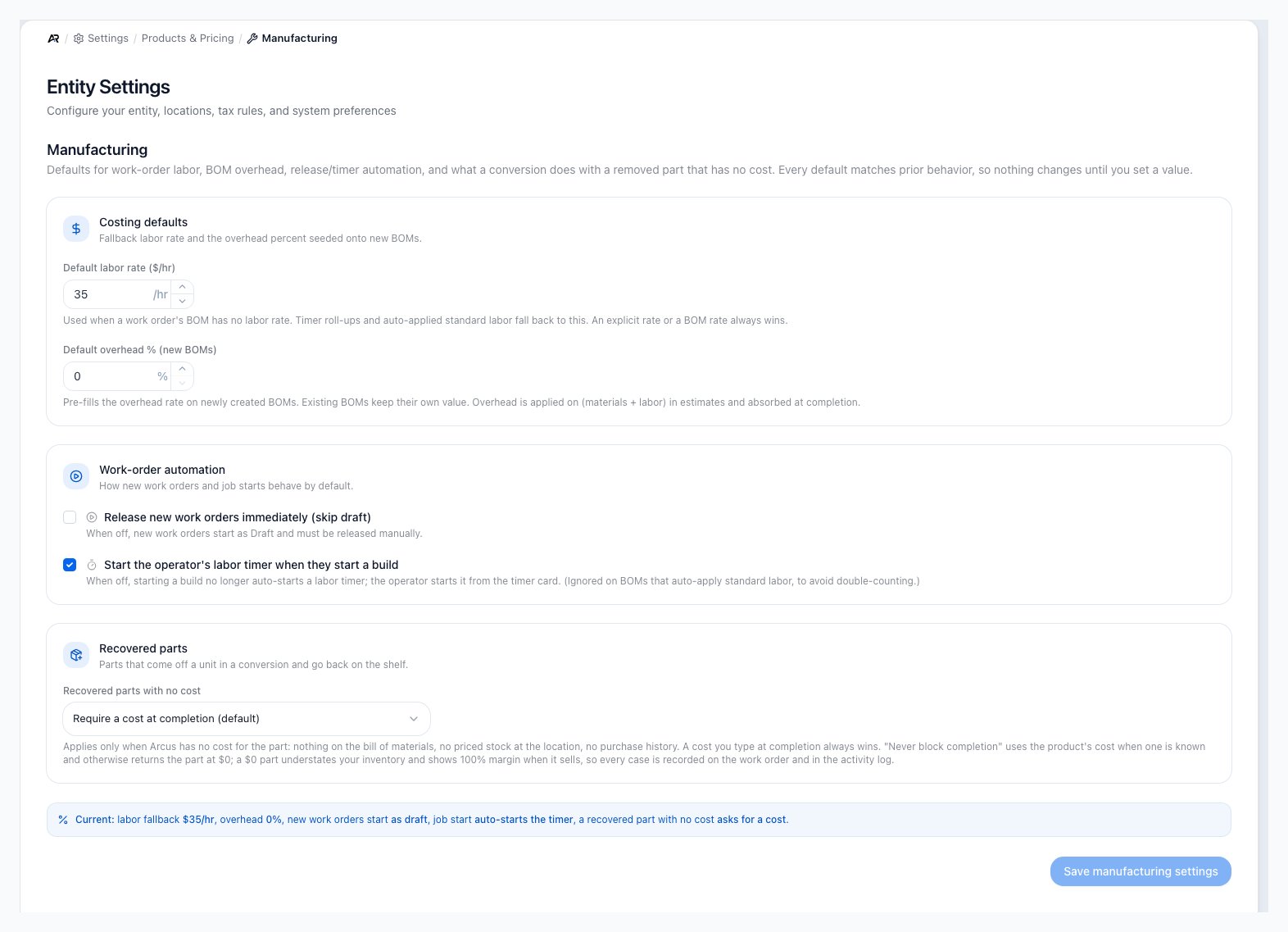
The Manufacturing screen in Settings.
Open Manufacturing Settings
You need settings.edit. The Manufacturing settings leaf is hidden when your role cannot edit it, and opening the page from a link shows Access Restricted with a Back to Settings button.- In the deck, open Settings.
- Under Products & Pricing, choose Manufacturing.
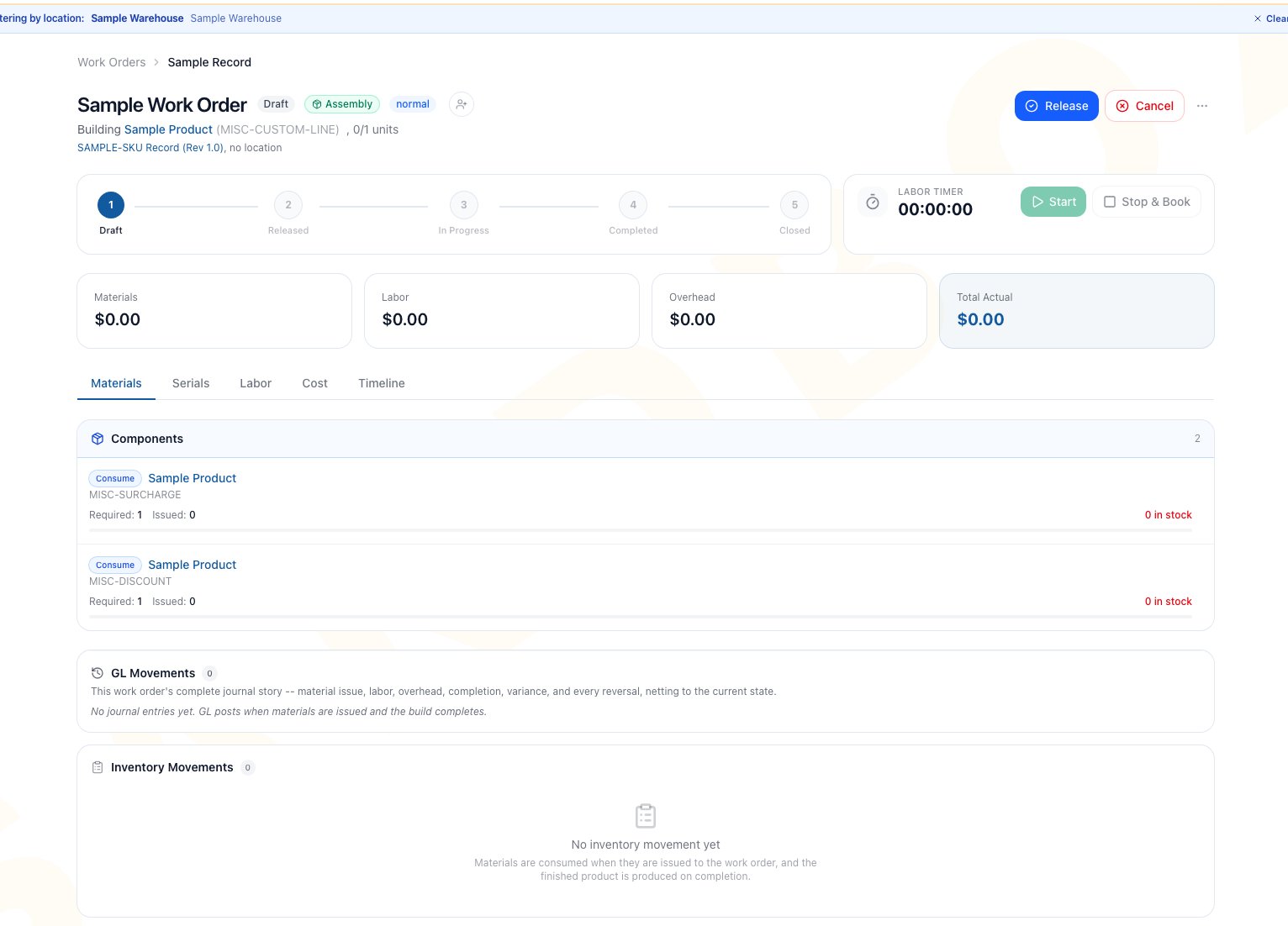
After changing Manufacturing settings, verify the resulting Draft or Released state and labor-timer behavior on one controlled work order. This downstream orientation image shows the status and timer controls, not the Settings page.
- Confirm you are in the correct company.
- Review the current summary at the bottom of the page.
- Identify which creation and floor workflows the change will affect.
- Tell planners and operators before enabling an automation setting.
- Save and test one controlled recipe or work order before broad use.
Choose The Setting To Change
Set The Timer Labor Fallback
Default labor rate ($/hr) is the final fallback when a stopped timer session is rolled into work-order labor cost. The timer rate is chosen in this order:- A valid explicit timer rate, when one was supplied.
- The work order’s BOM labor rate, when it is greater than zero.
- The positive company default on this page.
- The built-in $35/hr timer fallback.
Set Overhead For New BOMs
Default overhead % (new BOMs) seeds the overhead plan on BOMs created after the setting is saved. New BOM creation does not ask for overhead, and the current BOM detail has no overhead editor. Set the company default before creating the recipe.- Enter zero or a positive percentage.
- Save the settings.
- Create a controlled BOM.
- Verify the overhead percentage in its cost plan before activation.
- If it is wrong, leave that BOM in Draft, correct the company setting, and create a replacement BOM.
Decide Whether To Skip Draft
Turn on Release new work orders immediately (skip draft) only when standalone creation paths are ready to pass directly into Released work. This company setting is independent of the release checkbox on the manual New Work Order page. When enabled, Arcus attempts the normal release workflow immediately after creating a standalone work order. This includes:- Manual New Work Order creation.
- A work order created from an MRP suggestion.
- Eligible work created through sales-order or invoice Build All.
The manual page checkbox starts selected and makes its own Release request after creation. When the company setting is off, leaving that checkbox selected can still release the order. When the company setting is on, clearing the checkbox cannot force Draft because the company setting can release the order during creation. To request a Draft from the manual page, turn off the company setting and clear the page checkbox.
Control Timer Start On Build Start
Start the operator’s labor timer when they start a build controls what happens after an eligible operator clicks Start on a work order. When enabled, Arcus starts the work order and then tries to start that operator’s labor timer when:- The operator has manufacturing edit access.
- That operator does not already have an active timer on the work order.
- The BOM is not configured to auto-apply standard labor at completion.
BOMs that auto-apply standard labor do not auto-start a timer. This prevents the same planned labor from being recorded by both mechanisms.
Decide What Happens To A Recovered Part With No Cost
A conversion work order takes a part off a unit and, when that part goes back to stock, completion needs a cost for it. Recovered parts with no cost decides what happens only when Arcus has no cost at all for the part: nothing on the bill of materials, no priced stock at the location, and no purchase history. A cost you type at completion always wins.- Require a cost at completion (default): completion stops and lists every recovered part that has no cost. Completing the work order asks for what one of each part costs you before it goes back on the shelf, and an authorized person can set it in the Costs needed step.
- Never block completion: completion goes ahead. A part with a known product cost goes back at that cost; otherwise it goes back at $0.
Save And Verify Changes
- Review all five displayed values. The save action sends them together.
- Click Save manufacturing settings.
- Wait for “Manufacturing settings saved”.
- Confirm the current-value summary matches the intended behavior.
- Test the affected workflow with one controlled BOM or work order.
While the save runs, the button reads Saving, one moment. Other open sessions refresh when the settings change, including a change another system makes through the Arcus API.
Common Scenarios
Standardize timer labor for BOMs without a rate
Set a positive default labor rate, save, then run and stop a timer on a controlled work order whose BOM has no positive labor rate. Verify the booked labor rate and cost. Manual labor and auto-applied standard labor still require their own rate decisions.Review every job before release
Keep Release new work orders immediately (skip draft) off. On the manual New Work Order page, also clear the selected Release immediately checkbox. MRP and Build All then preserve a Draft review, while Combined Run members remain Draft by design.Let planners create floor-ready standalone jobs
Enable automatic release only after active recipes, locations, material gates, and responsibilities are consistent. Verify the status of each record because a release refusal can leave it Draft.Keep conversions from stopping on a part with no cost
Choose Never block completion only when you accept that a recovered part with no known cost goes back at $0. Review the work order and the activity log afterward, and set the part’s cost so later receipts and returns use a real number.Use standard labor without a timer
Enable auto-applied standard labor on the BOM and set its planned minutes and labor rate there. The job-start timer setting is ignored for that BOM.Troubleshooting And Refusals
- Manufacturing is missing from Settings: your role needs settings.edit.
- Save is disabled: no value has changed, or a save is already in progress.
- Default labor rate is refused: enter a finite number that is zero or greater.
- Default overhead is refused: enter a finite percentage that is zero or greater.
- A zero labor fallback still books $35/hr: zero does not override the built-in timer fallback. Enter a positive value for a different timer fallback.
- Manual labor did not use the default: enter the required rate on the manual labor record. This setting is for timer roll-up.
- Auto-applied standard labor used a different rate: review the BOM labor rate and standard-labor setup. The company timer fallback does not control that completion path.
- A new BOM did not use the overhead default: leave it in Draft, verify the saved value and company, correct the setting, and create a replacement BOM.
- A new work order stayed Draft while automatic release was on: the release attempt is best-effort. Open the order, resolve the normal release gate, and release it manually.
- You cleared the page’s Release immediately checkbox, but the order is Released: the company automatic-release setting is on and can release the order independently.
- The company automatic-release setting is off, but a manual order is Released: the page checkbox starts selected and made its own Release request. Clear it when Draft review is required.
- Completion stopped on a recovered part: the part has no cost and the setting is on Require a cost at completion. Enter the cost it asks for, or choose Never block completion if you accept a $0 return.
- A recovered part came back at $0: the setting is Never block completion and Arcus had no cost for the part. Set the part’s cost and review the work order.
- A combined-run member stayed Draft: that is expected. Release combined members individually.
- The job started but the timer did not: check edit access, active timer state, BOM standard-labor automation, and the displayed timer message. Start the timer manually when appropriate.
FAQ
Are these settings retroactive?
No. They do not rewrite existing BOMs, work-order snapshots, booked labor, inventory movements, or accounting entries.Does automatic release start the work order?
No. Released and In Progress are different states. The floor still starts the job through the work-order workflow.Which control wins, the company setting or the New Work Order checkbox?
They are independent release paths. The company setting can release a standalone order even when the page checkbox is cleared. The selected page checkbox can release a manual order even when the company setting is off. Turn off the company setting and clear the checkbox to request Draft, then verify the resulting status.Does the default overhead change every BOM?
No. It seeds new BOMs created after the setting is saved; existing BOMs keep their own value, and the current BOM detail has no overhead editor.Does the recovered-part setting change a part that already has a cost?
No. It applies only when Arcus has no cost for the part. A cost you type at completion always wins.Does the timer setting start labor for every user?
No. It applies to the operator who starts an eligible build and still respects access, active-timer, and BOM labor gates.Why did MRP create a Released work order when its button said draft?
The standalone automatic-release setting applies after MRP creates the work order. Verify the status every time this setting is on.Related Guides
Creating BOMs
Verify how new overhead, labor, output quantity, and recipe type are captured.
Bills of Materials
Manage the recipe-specific labor rate, overhead, lifecycle, and revision history.
Work Orders
Review Draft and Released outcomes and the normal status gates.
Labor Tracking
Choose timer, manual, or automatic standard labor without double-booking.
Combined Runs
Review and release Draft members separately from standalone automatic release.
MRP Planning
Understand why a suggested work order can finish creation as Draft or Released.