

Before You Change Status
- Confirm the exact product, variant, BOM type, revision, and current status.
- Review open work that already references the recipe.
- Preserve any required source documents before permanent deletion.
- Decide whether the existing recipe must remain explainable for history.
- Identify the Active and Default recipe that planning should use after the change.
- Review a current reverse-recipe relationship before revising or retiring either side.
Lifecycle Map
When a Superseded or Archived BOM has a newer Active sibling, View latest revision opens that current recipe without changing the historical record.
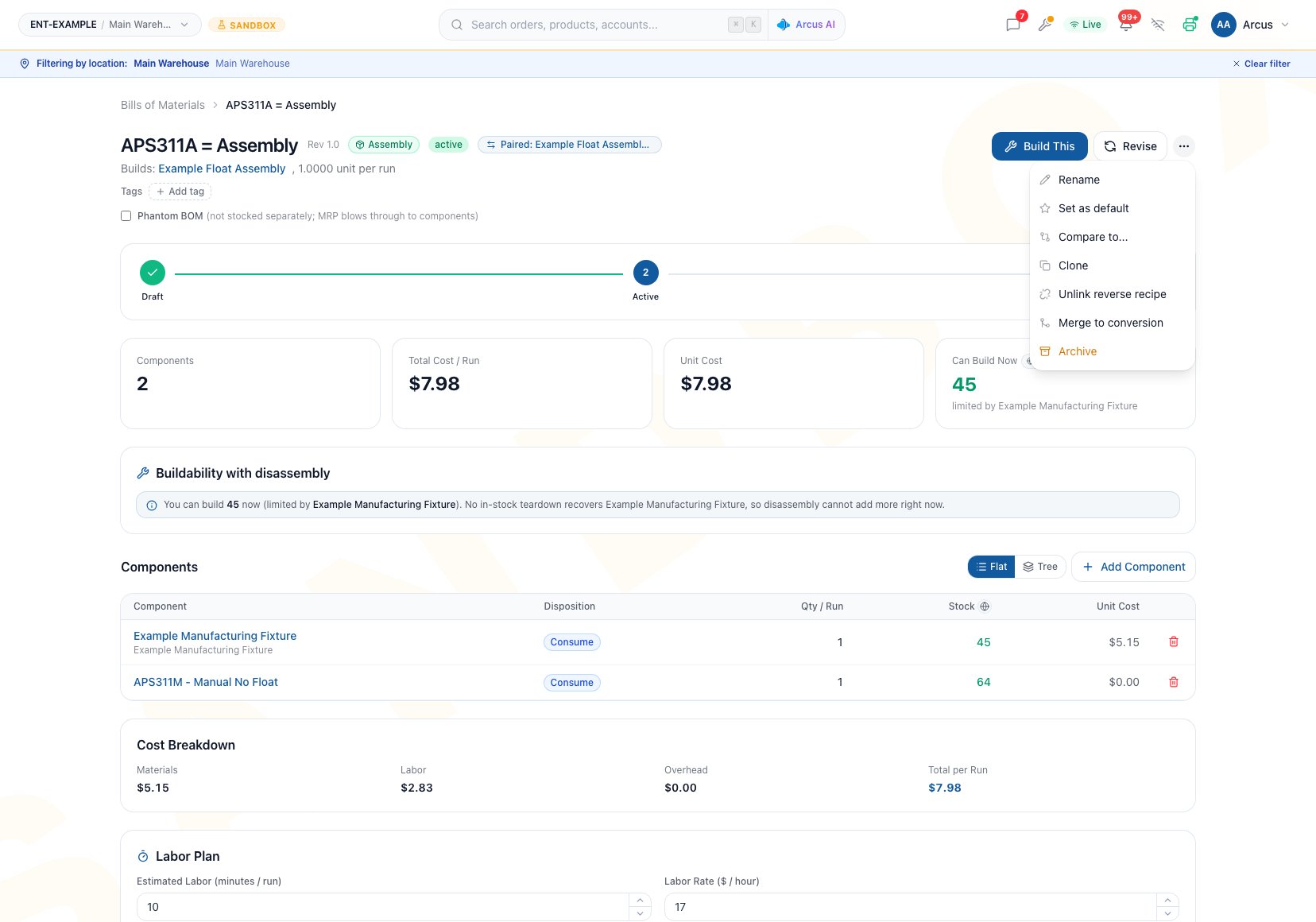
The status control, exact production action, revision action, and secondary lifecycle decisions remain visible from the BOM detail page.
Activate A Draft
Before starting, confirm the product and any conversion source, output quantity per run, component lines, dispositions, labor plan, phantom choice, and documents. The current detail page does not provide controls to change the source product, output product, output quantity, or overhead after creation.- Open the Draft BOM.
- Add and review every material line. On the current BOM page, Activate remains unavailable until at least one line exists.
- Review cost and availability with current recorded costs and stock.
- Confirm labor, documents, tags, and assembly-only phantom behavior where applicable.
- Click Activate.
- Confirm the status is Active before creating work.
Create A Revision
Use a revision when a live physical recipe must change but the old recipe must remain explainable.- Open the Active or Superseded BOM and click Revise.
- Enter a revision label, or leave it blank for the suggested increment.
- Keep Supersede the current revision selected when new work should move away from the current recipe.
- Create the revision.
- Review the new Draft before activation.
- Re-enable Phantom BOM intentionally when the new assembly revision should remain phantom.
- Activate the new revision and set it as default only after review.
Rename A Recipe Label
Use Rename when only the searchable label is unclear. Use a revision when materials, quantities, dispositions, source, output, labor, or physical instructions change.- Open a nonarchived BOM and choose Rename.
- Enter a different name with 255 characters or fewer.
- Click Save.
- Confirm the new label on the same recipe and revision.
Compare Revisions
- Open a BOM and choose Compare to… from the action menu.
- Select another revision for the same product and variant.
- Review Header Changes, Component Changes, and the limited Cost Comparison.
- Resolve unexpected added, removed, or changed lines before activation.
- Separately review Cost Breakdown, Recovery Preview, instructions, documents, and allocation controls when they apply.
Cost Comparison is a limited component view based on current base-product costs and raw line totals. It does not include source input cost, labor, overhead, return netting, recovery allocation, or changes made only to allocation percentages or instructions. It is a present-day planning aid, not proof of historical or complete recipe cost.
Choose The Default Safely
- Open the intended recipe and confirm its product, revision, and status.
- Use the star on the BOM list or Set as default on the detail page.
- Confirm that the intended row now shows the default star.
- For MRP, verify the same BOM is Active and the product planning settings qualify.
- The BOM is Active and Default.
- The product is active.
- The product tracks inventory.
- Its supply method is Manufactured or Both.
Clone Only As A Starting Point
Cloning creates a new Draft, but it should not be treated as a guaranteed correct cross-product copy.- Prefer cloning for a closely related draft, especially for the same product.
- Verify the target product, source and output identity, output quantity, every line, labor plan, and phantom setting.
- If the source, output, output quantity, or required overhead should differ, create a new BOM instead. The current detail page cannot correct those controls after creation.
- Activate only after the new draft independently passes review.
Archive Or Permanently Delete
Open the action menu and choose the available retirement action. Arcus decides the safe result from work-order history.
Read the confirmation carefully. Permanent BOM deletion cannot be undone. A new work-order reference found after the dialog opened can change the result or block the action.
Restore An Archived BOM
- Open Manufacturing > Bills of Materials.
- Include Archived in the status filter.
- Open the archived recipe and click Restore.
- Review the returned status, recipe, and documents.
- Revise or reactivate only after confirming that the process is still valid.
- Set a default deliberately if planning should use the restored recipe.
Common Scenario: Release A Safer Recipe
A shop changes one component on its active assembly recipe.- Create a revision and leave Supersede the current revision selected.
- Replace the component in the new Draft and verify quantities, availability, cost, and instructions.
- Re-enable phantom behavior if the old assembly used it and the new revision should too.
- Activate the new revision.
- Set it as default after approval.
- Compare it to the Superseded recipe and retain the old record for work-order history.
Troubleshooting And Refusals
- Activate is unavailable: On the BOM page, add at least one line and confirm you have edit permission.
- Revise is unavailable: Confirm you have create permission and that the current status supports a revision.
- The revision lost Phantom BOM: This is expected. Revision does not copy the phantom flag; re-enable it intentionally on a qualifying assembly.
- MRP stopped using the product after revision: Confirm the new revision is Active and Default and that product planning settings still qualify.
- Compare has no usable choice: Arcus only compares sibling BOMs for the same product and variant. A product sibling for another variant can appear in the picker but cannot be compared.
- Delete became Archive: The BOM has work-order history. Arcus preserves the recipe for traceability.
- Retirement is blocked: Complete or cancel referencing Draft, Released, or In Progress work orders first.
- Restore returned Superseded: Another active sibling already exists. The restored record will not replace it automatically.
- The restored reverse link is missing: Restore does not recreate reverse pairing. Review both recipes and their current lifecycle state; do not assume the former relationship still exists.
FAQ
Can a Draft or Superseded BOM be default?
Can a Draft or Superseded BOM be default?
Technically yes, as long as it is not Archived. It will still not qualify for MRP because MRP requires the default BOM to also be Active.
Does a revision copy Phantom BOM?
Does a revision copy Phantom BOM?
No. The new revision is a Draft without the phantom flag. Re-enable it intentionally only when the assembly should still explode through MRP.
Does revising copy the reverse-recipe relationship?
Does revising copy the reverse-recipe relationship?
A current pairing moves to the new revision. Archiving clears the link, and restoring later does not bring it back.
Can I recover a permanently deleted BOM?
Can I recover a permanently deleted BOM?
No. Permanent BOM deletion cannot be undone, and its attachments are no longer available from that BOM. Preserve any required source files before confirming deletion.
Related Guides
Bills Of Materials
Find a recipe and choose the correct production type.
Create A BOM
Build and verify a new Draft before activation.
Reverse Recipes
Generate, review, unlink, and merge paired recipes.
BOM Documents
Attach and retain the instructions that support each controlled revision.
MRP Planning
See how active default BOMs become planning candidates.