

Use Operations > Fulfillment > To Pack as the packing to-do list. It lists every open sales order that still has physical units not yet in a package, starting with the order that has waited longest. Select an order to open its pack page, where you build packages, scan items and buy labels.
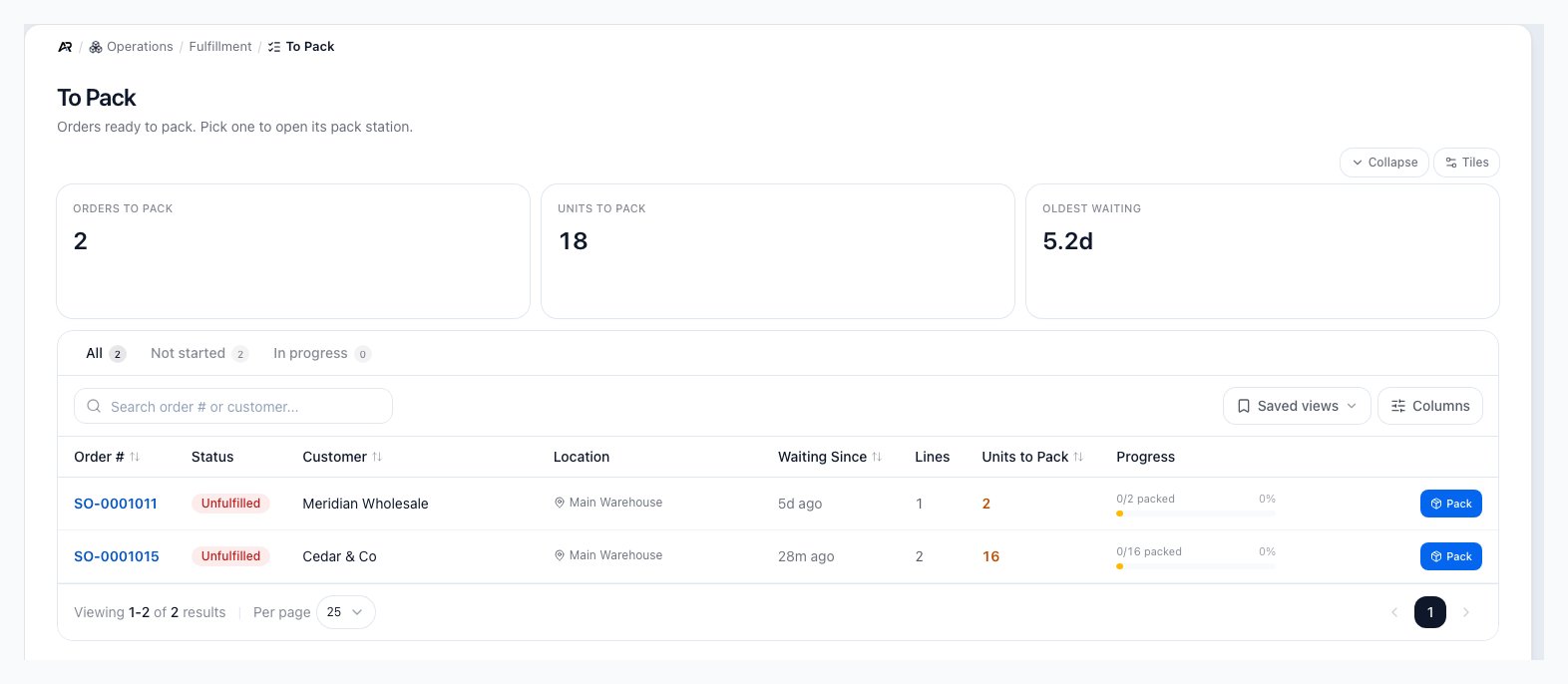
The To Pack screen in Operations.
Before You Start
- Permissions: opening the list needs View Fulfillment. Opening an order’s pack page needs Pack Orders; without it, Pack still shows but the pack page does not open for you.
- Location: the list follows the location picked in the header and the locations your user may work at. Orders with no location show at every location.
- Which orders appear: sales orders that are open or processing and still have units to pack. The list counts only physical units that ship from your stock, so it leaves out:
- drop-ship lines, which the vendor ships directly;
- kit and variant parent lines (their components are counted instead);
- lines whose stock reservation was released on purpose to wait for a purchase order;
- units already in a package, packed or shipped.
- Search for To Pack in the command palette.
Read the List
The header reads To Pack: “Orders ready to pack. Pick one to open its pack station.” Three tiles sit above the list:- Orders to pack: how many orders have units left to pack.
- Units to pack: the total units left across those orders.
- Oldest waiting: how many days the oldest order has waited since it was created. It turns red at two days or more.
- All: every order with units to pack.
- Not started: no unit on the order is packed yet.
- In progress: some units are packed and some are not.
The list starts with the oldest order, so packing goes first in, first out. Select a column header to sort by Order #, Customer, Waiting Since or Units to Pack instead.
Search matches the order number and the customer name. Saved views keep a tab, search, sort and column layout, and Columns hides, shows or reorders columns. The search, tab, sort and page stay in the page address, so going Back from a pack page, refreshing, or sharing the link keeps them.
When nothing is waiting, the list says “Nothing to pack” and “All fulfillable orders at this location are packed. New orders appear here as they are paid and ready.” If the list cannot load, a red notice reads “Could not load the pack queue.” followed by the reason.
Pack an Order
- Open Operations > Fulfillment > To Pack and confirm the location in the header.
- Pick an order. Start with Not started for new work or In progress to finish orders someone began.
- Select the row or Pack. The order’s pack page opens, titled Pack with the order number.
- Build the packages: add a package or pallet, scan or pick the items, and get rates and a label. The pack page is described in Fulfillment Station under “Pack One Order”.
- Return to To Pack for the next order. When every unit on the order is in a package, the order leaves this list.
What Changes Here
The list itself changes nothing: it only reads orders. It refreshes on its own when someone creates a package, changes a package’s items, fulfills a package or edits the order, so two packers see the same list. Packing, labels and fulfillment change stock, the ledger and the customer’s emails on the pack page and the Fulfillment Station; see Fulfillment Station for those side effects.Common Scenarios
- An order is missing: check the header location, whether all of its units are already in packages (look on the Fulfillment Station), whether its lines are drop-ship, and whether the order is still a draft or quote.
- Pack does not open the pack page: your user needs Pack Orders.
Related Articles
Fulfillment Station
Operations > Fulfillment > Fulfillment Station: the pack page, labels, printing and Mark as Fulfilled.
Pack with Mighty
Let Arcus pack the remaining units into suggested boxes.
Pick Lists
Operations > Fulfillment > Pick Lists: send staff to the right bins before packing.
Freight Queue
Operations > Fulfillment > Freight Queue: orders that ship on pallets.
No-show Queue
Operations > Fulfillment > No-show queue: pickup orders that were never collected.
All Orders
Sales > Orders > All Orders: open an order behind a row.