

Choose Your Starting Point
Understand The Recipe Types
All three types use the same Draft, Active, and Superseded recipe lifecycle. Only an Active BOM can be selected for new work. Use BOM Lifecycle for activation, revision, default, supersede, archive, and restore decisions.
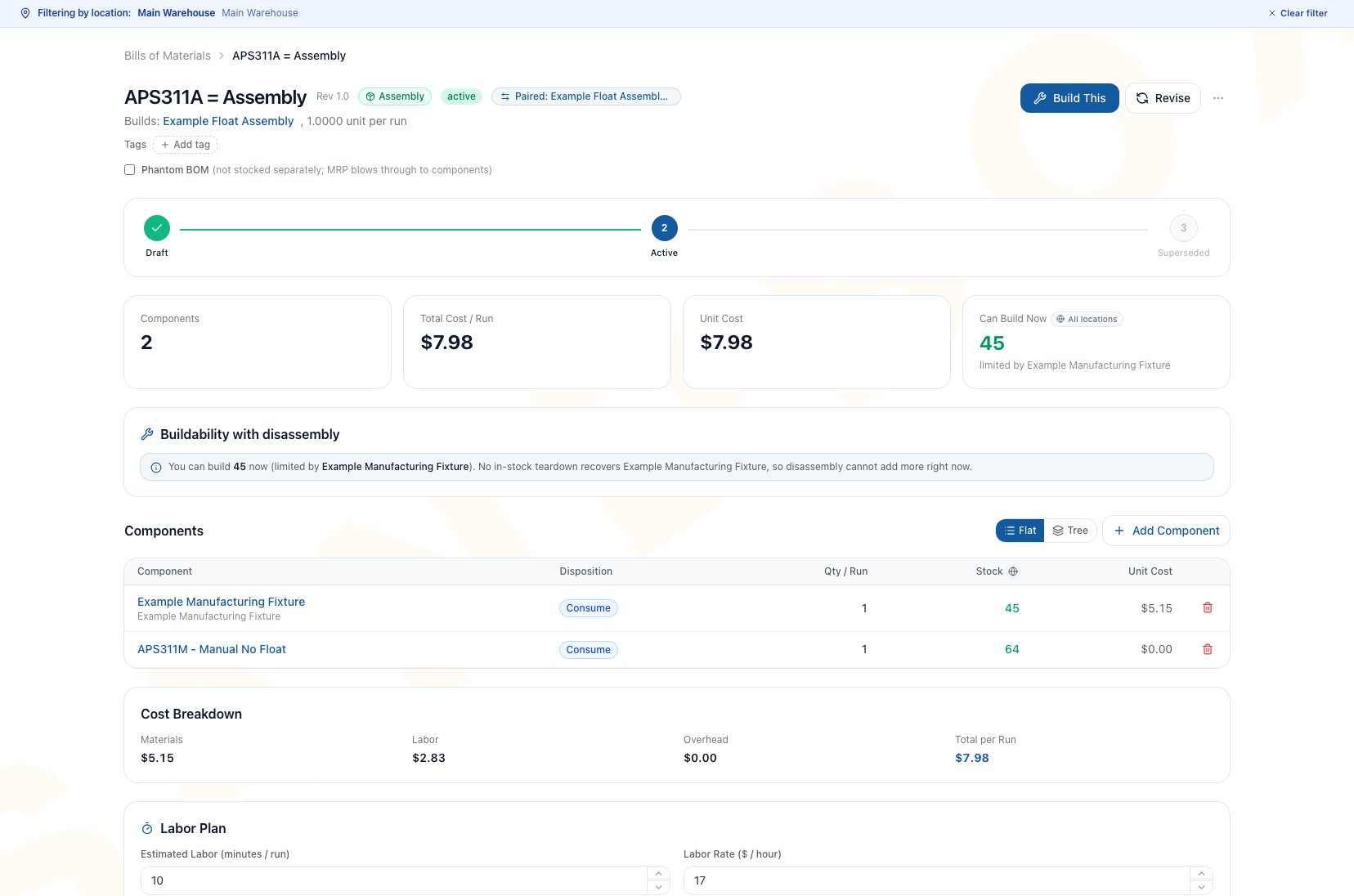
An active assembly BOM shows its lifecycle, components, buildability, cost per run, and labor plan before work begins.
Prepare The Product First
For a stocked product that Arcus should manufacture:- Open the product.
- Set its supply method to Manufactured or Both when the product can be purchased or manufactured.
- Open the product’s Manufacturing tab.
- Create or review the active recipes under Build Recipes (BOMs).
- Star the active recipe that should be the default for MRP and sales-document manufacturing.
- Review Recent Work Orders, Where Used, and the supply buildability result before committing work.
Create Work From The Right Source
The creation source changes what is preselected and whether several records can be created.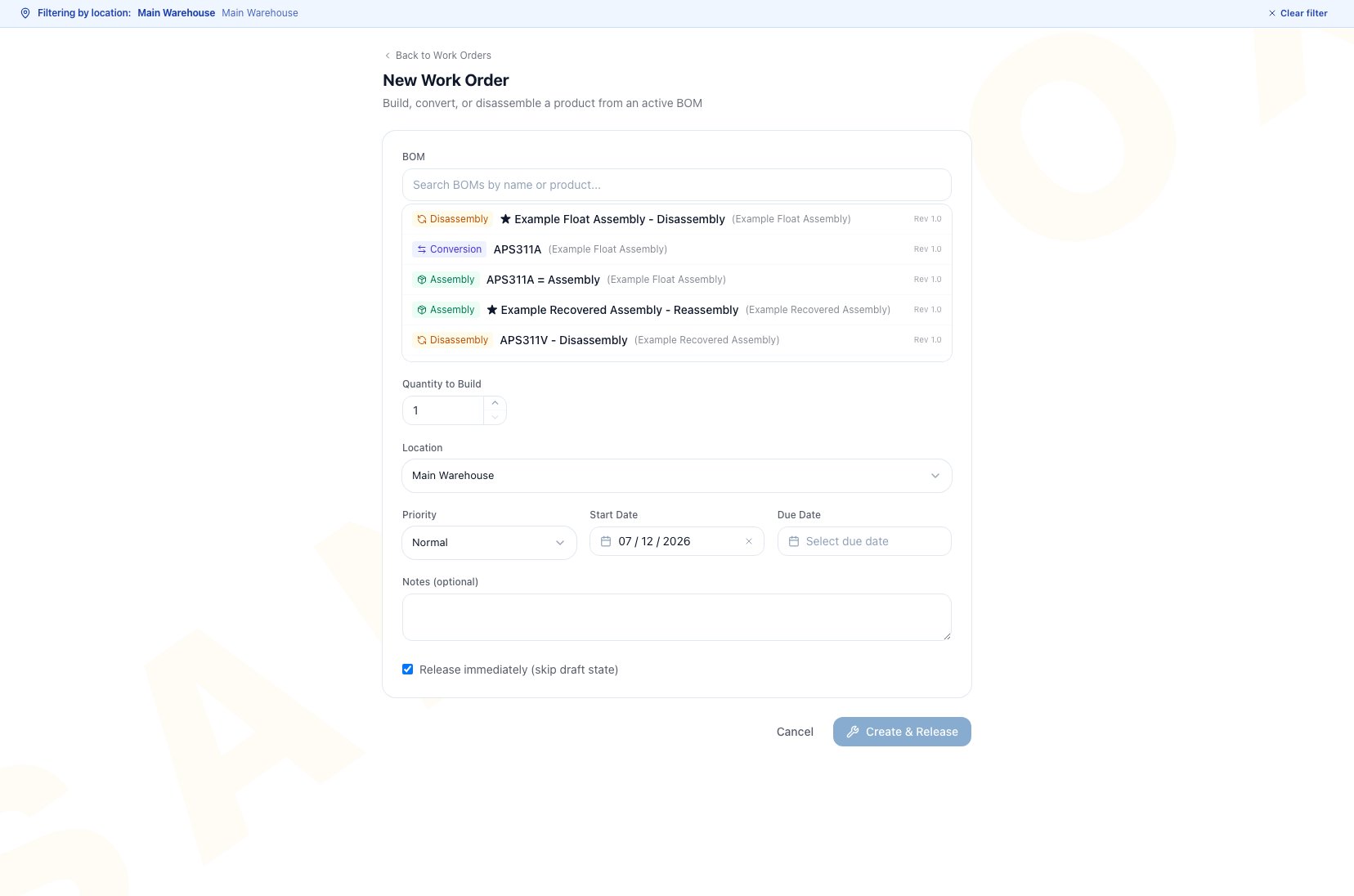
New Work Order begins with the Active BOM picker open. After choosing a recipe, review quantity, location, dates, notes, and the immediate-release choice.
Use Build All From Sales Documents
An eligible sales order or invoice can show a Manufacturing section with Build All. Arcus considers manufactured lines, skips kit-component child lines, and does not create another work order for the same document line when a non-cancelled work order is already linked. Before clicking Build All:- Confirm every intended product is Manufactured or Both.
- Confirm each product has an Active BOM. The starred default is preferred; otherwise Arcus uses the most recently updated active recipe.
- Check the Manufacturing setting that controls automatic release.
- Decide whether the sales order or the invoice will be the single manufacturing source for this sale.
Run A Work Order Through Its Lifecycle
Use Work Orders for queue views, statuses, start, completion, close, and cancellation. The work-order detail is the source of truth when a group, planning page, or sales document shows only a summary.
Follow Materials, Labor, Serials, And Cost
Manufacturing activity is not only a status change:- Material issues move component value into work in process. Returns, scrap, and approved substitutions change the actual material story.
- Timer sessions, manual labor, or configured standard labor record the labor actually charged to the job.
- Completion adds the finished or recovered product and relieves the appropriate work-in-process cost. Serialized output requires the serial details demanded by the completion workflow.
- Closing completes the final operational and cost review. Use the work order’s inventory, cost, completion, and GL history for transaction-level evidence.
Coordinate Planning Without Mixing Ledgers
- Combined Runs coordinate members and intermediate flow. Each member keeps its own materials, labor, completion, inventory, and accounting history. The group does not post a separate manufacturing ledger.
- Production Planning (MRP) calculates suggestions. Running MRP alone does not change stock or accounting. Created work orders and purchase orders follow their own lifecycles.
- Reports summarize current work-order data. Correct the owning BOM, work order, inventory record, or accounting record rather than trying to edit a report result.
Check Linked Sales Work Before Cancellation
Before cancelling or voiding a sales document, inspect its linked manufacturing work:- Draft or Released child work orders can be cancelled as part of the sales-document cancellation flow.
- In Progress work blocks that cancellation until the work order is addressed directly.
- Completed or Closed child work orders block sales-document cancellation. Process the finished goods through the appropriate RMA or scrap workflow, then retry cancellation.
Troubleshooting And Refusals
- The Manufacturing tab has no build actions: set the product supply method to Manufactured or Both, then create an Active BOM.
- A BOM is missing from New Work Order: confirm the recipe is Active and belongs to the intended product or variant.
- Build All is missing or disabled: confirm the document is a sales order or invoice with manufactured lines, at least one eligible Active BOM, and a status that still allows manufacturing.
- Only some Build All lines created work: inspect the linked list and product lines, fix the missing recipe or line-specific gate, and retry only after confirming which work already exists.
- MRP does not analyze a product: verify active status, inventory tracking, Manufactured or Both, and an Active default BOM.
- Release is refused: confirm edit permission, current Draft status, and the request result. A shortage does not block Release, but it can block material issue or completion and still must be resolved before the floor consumes or completes work.
- A sales document cannot be cancelled: review linked In Progress, Completed, or Closed work and follow the manufacturing decision required for that state.
Common Scenarios
Build from forecast and open demand
Set the product to Manufactured or Both, activate and star the intended default BOM, then run Manufacturing > Production Planning. Review the suggestion’s demand and supply, create or customize the work order, and verify whether it is Draft or Released before the floor begins.Recover a component and use it in another build
Use a Disassembly BOM for the teardown and an Assembly BOM for the later build. Plan a Combined Run when both jobs need shared sequence and flow context, but complete the teardown member before treating its recovered product as available stock.Manufacture items for a sale
Use Build All from either the sales order or the invoice, not both. Inspect linked work after the action because eligible lines are evaluated independently and some can be created while others are skipped.FAQ
Does the starred default BOM control every creation path?
No. MRP and Build All prefer the Active default. Product Build This Product preselects the most recently updated Active BOM, so verify the recipe on the form.Does releasing a work order move inventory?
No. Release commits the job to the manufacturing workflow. Material, completion, return, scrap, and other physical actions create inventory effects later.Does running MRP reserve stock or post cost?
No. MRP calculates suggestions. Created work and purchase records follow their own lifecycles.Where are serial numbers recorded?
Follow the serial prompts on the work order’s material and completion workflows. Serialized output requires the completion serial details for the quantity being completed.Can cancelling a sales document erase completed manufacturing?
No. A Completed or Closed child work order blocks sales-document cancellation. Process the finished goods through the appropriate RMA or scrap workflow, then retry cancellation; the manufacturing, inventory, and accounting history remains intact.Related Guides
Recipes And Readiness
Bills of Materials
Choose recipe types, components, phantoms, cost, availability, documents, and paired recipes.
Creating BOMs
Create an Assembly, Disassembly, or Conversion recipe with correct quantities, cost, labor, and instructions.
BOM Lifecycle
Activate, revise, set a default, supersede, archive, or restore a recipe without rewriting work history.
Disassembly And Conversion
Take a stocked product apart or transform inputs into different outputs.
Reverse Recipes
Pair forward and reverse recipes without assuming one reverses the other’s transactions.
BOM Documents
Attach and maintain drawings, work instructions, and other controlled recipe documents.
Buildability
Read current availability, limiting components, phantom expansion, and teardown recovery options.
Work Execution
Work Orders
Create, release, start, complete, close, cancel, and review one manufacturing job.
Materials And Substitutions
Issue, return, scrap, and substitute components with the correct inventory result.
Labor Tracking
Use timers, manual entries, and standard labor without double-booking cost.
Partial Completions And Undo
Complete in stages, capture serials, and reverse only eligible completion activity.
Travelers
Print the work-order traveler used by operators on the floor.
Planning, Review, And Control
Combined Runs
Coordinate two or more Draft member work orders and review intermediate product flow.
MRP Planning
Compare demand with stock and open supply, then create selected work and purchase records.
Manufacturing Reports
Review WIP age, cost variance, completed output, and component usage.
Manufacturing Settings
Control new-BOM overhead, timer labor fallback, automatic release, and automatic timer start.
Product And Inventory Foundations
Use these references when a Manufacturing guide sends you back to product eligibility, costing, serial setup, or movement history.Product Setup
Prepare the physical product or child variant that Arcus will stock, build, disassemble, or convert.
Product Types And Costing
Choose the right product type and understand how current product and inventory costs affect manufacturing estimates.
Serial Numbers
Review unit-level identity and history when a source, material, or completed output is serialized.
Inventory Transactions
Audit the stock movements and FIFO cost layers created by manufacturing actions and reversals.