

Use Operations > Fulfillment > No-show queue to work pickup orders that are ready but still waiting for the customer. Every order here is awaiting pickup and its pickup-ready time has passed, so the list shows how long each order has waited, what is still owed, and whether the customer already paid. When an order is genuinely abandoned, mark it no-show from here. Arcus never marks an order no-show on its own.
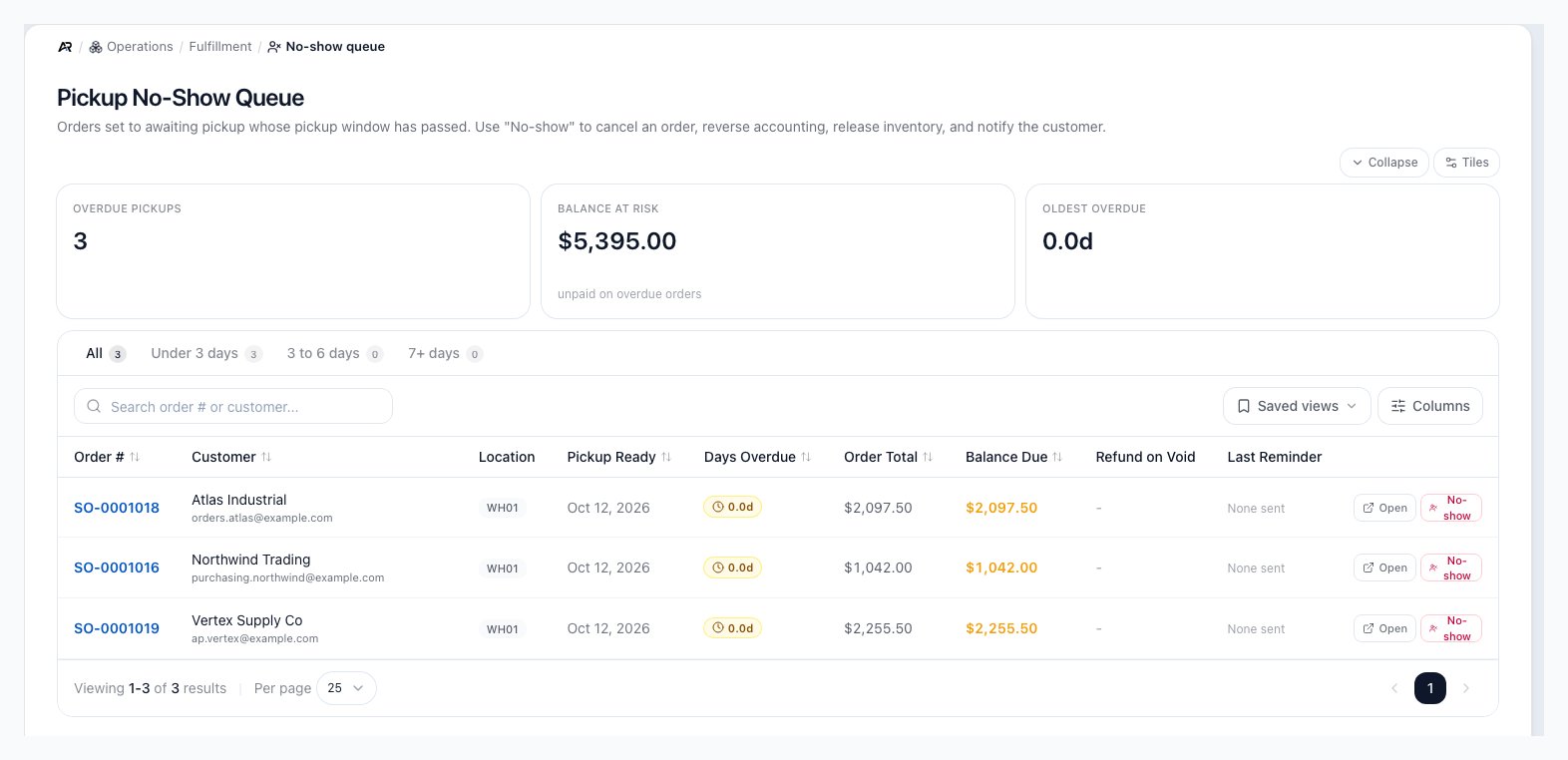
The No-show queue screen in Operations.
Before You Start
- Permissions: opening the queue needs View Fulfillment. The No-show button shows for everyone who can open the queue, but marking an order no-show needs Edit Orders, and loading the confirmation needs View Orders. Without them, Arcus refuses the step.
- Which orders appear: pickup orders that are awaiting pickup, are not cancelled, and have a pickup-ready time in the past. An order joins the queue as soon as its pickup-ready time passes and leaves it when it is picked up, cancelled, or marked no-show.
- Location: the queue follows the location picked in the header. Orders with no location show at every location.
- Reminders: Arcus emails the customer pickup reminders on the days set under Pickup Reminders at Settings > System > Approval Workflows (3, 7 and 12 days after the order is ready, by default). The Last Reminder column shows the most recent one.
- Search for No-show queue in the command palette (it also answers to “will call” and “pickup”).
- The No-show queue item in the Operations navigation shows a count of overdue pickups.
Read the Queue
The page header reads Pickup No-Show Queue: “Orders set to awaiting pickup whose pickup window has passed.” Three tiles sit above the list:- Overdue pickups: the number of orders in the queue.
- Balance at risk: the unpaid balance across the overdue orders.
- Oldest overdue: how many days the longest-waiting order has waited. It turns red at seven days or more.
The list starts with the longest-waiting orders. Select a column header to sort by Order #, Customer, Pickup Ready, Days Overdue, Order Total or Balance Due.
Search matches the order number and the customer name. Saved views keep a tab, search, sort and column layout, and Columns hides, shows or reorders columns. The search, tab, sort and page stay in the page address, so going Back from an order, refreshing, or sharing the link keeps them.
Select a row, the order number, or Open to open the order. When nothing is overdue, the list says “No overdue pickup orders” and “All awaiting-pickup orders are within their pickup window.”
Mark an Order No-Show
Mark an order no-show only when the customer will not collect it: they told you so, or they have not answered your reminders and calls. If the customer already collected the order, open it and select Confirm Pickup instead.- Find the order. Use the 7+ days tab or sort by Days Overdue.
- Select No-show on its row.
- Read Mark Customer No-Show. Under This action will, Arcus lists what happens to this order: the payment line, Release reserved inventory back to stock., the ledger reversal, and Email a cancellation notice with the customer’s email when the customer has one.
- Optionally enter a Reason. It is saved with the cancellation on the order.
- Select Mark No-Show.
What Mark No-Show Changes
- The order: it is cancelled, the no-show date is stamped on it, and your reason is kept with the cancellation.
- Stock: the reserved inventory goes back to stock.
- The ledger: the sale’s revenue and cost of goods sold, its sales tax (including at your connected tax service), and any shipping and discount postings are reversed. The original entries stay for the audit trail, and the reversing entries net them out.
- Payments: Arcus does not refund anything automatically. Any amount the customer paid stays on their account as a credit, and a refund-owed note for each payment is added to the order’s activity. A person then decides whether to refund it, keep it as credit, or apply it to another order. When the dialog shows a payment line, read it as the amount that is owed back, not as a refund that will be sent.
- The customer: when the customer has an email address, Arcus emails a no-show notice. When the customer paid, it acknowledges the payment on file and says your team will be in touch about it; it names a refund only when one was actually issued on the order.
- Audit and refresh: the no-show is recorded in the activity log as a customer no-show by staff, and everyone with the queue or the order open sees the change without reloading.
Messages You May See
Related Articles
Pickup Customer No-Show
How pickup reminders and the no-show workflow fit together.
All Orders
Sales > Orders > All Orders: open the order behind a queue row.
Apply Account Credit
Use the credit a no-show leaves on the customer’s account.
Cancel Order Decision Tree
Choose between no-show, cancel, void and return.
Fulfillment Station
Operations > Fulfillment > Fulfillment Station: the Pickup filter shows pickup packages.
Freight Queue
Operations > Fulfillment > Freight Queue: freight orders by stage.