

Check access and readiness
Go to Manufacturing > Work Orders and open the work order. To complete, you need:- manufacturing.complete permission.
- A work order in Released or In Progress status.
- A work-order location.
- A positive whole-number quantity no greater than the remaining planned quantity.
- Enough entity-wide stock for every input that completion must backflush.
- Enough source stock for disassembly or conversion.
- Exactly one unique output serial per completed serialized assembly or conversion unit.
Complete a batch
- Click Complete Build, Complete Disassembly, or Complete Conversion in the work-order header.
- Enter Quantity to Complete as a whole number. Use Complete 1, Half, or All remaining when the relevant quick choice appears.
- For disassembly, review Cost Allocation Preview. Its percentages are a planning preview; actual amounts use FIFO source cost at completion.
- For serialized assembly or conversion output, enter exactly one unique serial per completed unit, one per line.
- If you enter the optional Lot Number, use an existing active lot code.
- Recheck the current progress and remaining quantity.
- Click Complete.
- Verify the new completed quantity, status, serials, costs, and both ledgers.
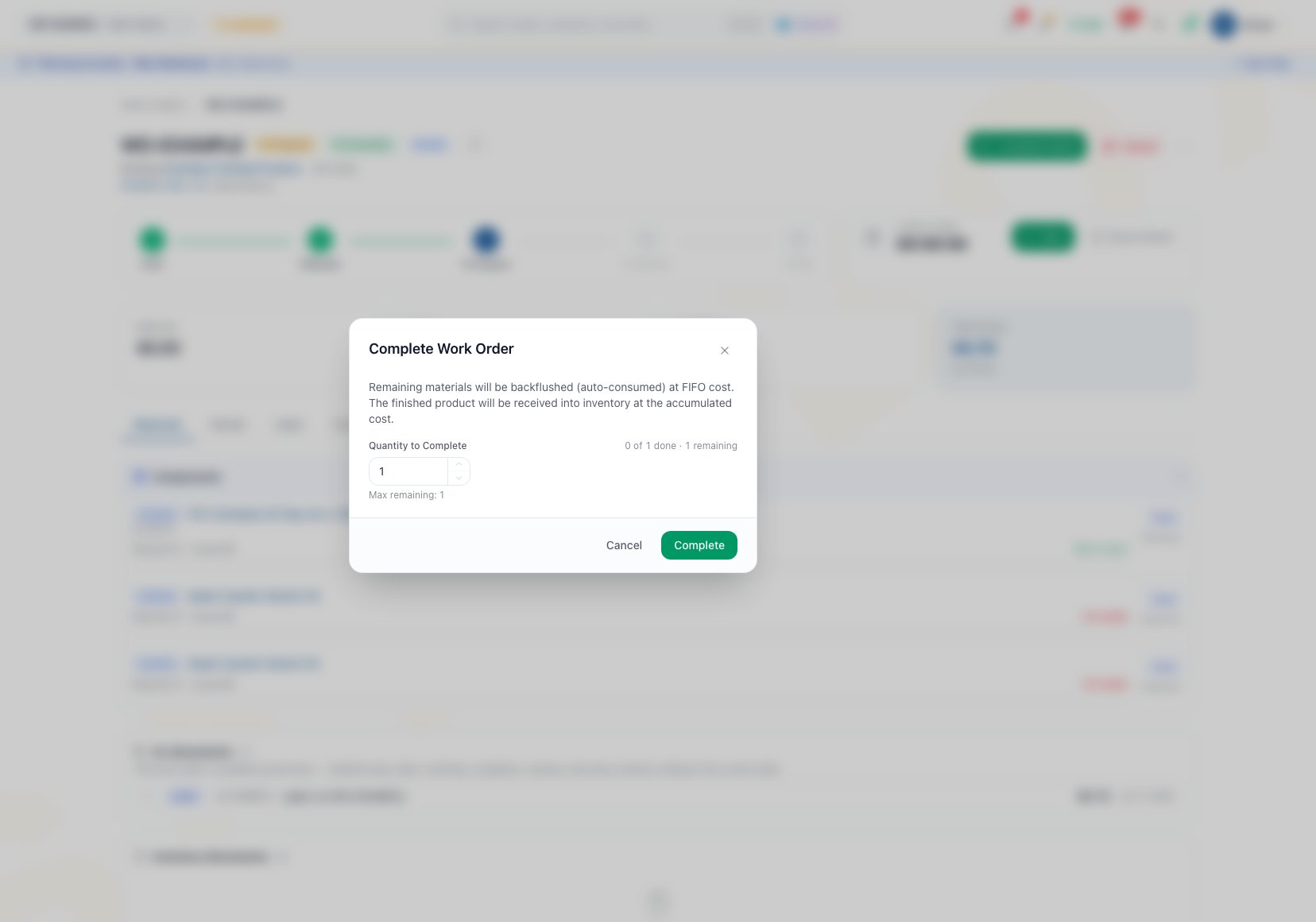
Complete Work Order records a whole-unit batch and shows current progress before posting inventory and cost.
Outcome
Completed quantity increases by the posted whole-unit batch. Arcus records its input, output, serial, cost, GL, inventory, and Timeline effects together. A partial batch preserves the previous Released or In Progress status; the final batch moves the order to Completed.Understand the type-specific result
Arcus checks the full completion batch before posting a backflush shortage. Input consumption uses actual FIFO cost, preferring the work-order location and then other entity locations. See Materials and Substitutions for location and issue behavior.
Understand the cost and GL result
Each completion is costed as its own incremental batch.- Material issued before completion is relieved in proportion to the cumulative completed share.
- Remaining required inputs are backflushed and relieved at actual FIFO cost.
- Disassembly and conversion source cost is relieved in the batch that consumes the source.
- Conversion Return-to-stock removed parts reduce the material value carried into converted output.
- Recorded labor is relieved by completion share. The final batch takes the remaining accrued labor.
- When BOM auto-applied labor is on, the batch creates its own standard labor entry before relief.
- BOM overhead is applied to the batch’s material and labor relief and is relieved with the same batch.
- Assembly and conversion output receives a FIFO layer at the batch’s actual relieved cost per unit.
- Disassembly recovered items split the batch’s relieved value using the BOM’s resolved allocation percentages, reconciled to the cent.
Disassembly completion resolves allocation percentages from the current BOM. Review Cost Allocation Preview immediately before completing an open order if that BOM has changed since the order was created.
Work with partial completions
A partial completion increases Completed Quantity but keeps the work order in its prior status, either Released or In Progress. Completing the final remaining unit changes the status to Completed.Common scenario: finish 4 of 10 units
- Start the Released work order so active floor work is visible as In Progress.
- Confirm material and labor for the first four units.
- Click Complete Build and enter
4. - Enter four unique serials if the output product is serialized.
- Complete the batch and verify
4 of 10on the header. - Review the batch’s produced inventory, backflush, actual cost, and ledgers.
- Keep the order In Progress while the remaining six units are worked.
- Complete
6only after the remaining output is physically ready.
If a partial completion is posted directly from Released, the order stays Released. The current UI does not show Undo last completion for that Released partial state.
Undo the newest eligible completion
The current work-order UI shows Undo last completion only when:- Status is Completed or In Progress.
- Completed quantity is greater than zero.
- Click Undo last completion (N units).
- Read the server-generated preview.
- Match the completion number and quantity to the physical batch.
- Review WIP restored, Output removed, Components restored, and Journal entries reversed.
- Check the status and completed quantity that will remain.
- Enter an optional reason.
- Click Undo Completion only when all listed output is still physically and systemically available.
- Verify the resulting status, quantity, stock, serials, Cost tab, GL Movements, Inventory Movements, and Timeline.
What Undo reverses
- Removes the newest batch’s intact produced FIFO layers.
- Restores input stock consumed by that batch.
- Deletes that batch’s produced serial records when they are still Available.
- Restores its consumed source serial to Allocated.
- Reverses the batch’s material, overhead, completion, and related journal entries.
- Restores relieved material, labor, and overhead to WIP.
- Removes auto-applied standard labor owned by that batch.
- Reduces completed quantity and restores the status saved before that completion.
Know every Undo refusal
When output was consumed or a serial moved, the refusal modal lists the blocking transactions or serials and does not show a confirm button.
Close only after the correction window
Once the full quantity is Completed, review the physical output, serials, materials, labor, cost, and ledger movements. Keep the order Completed while a legitimate completion correction may still be needed. Click Close only when the record is final. Close attempts to roll any remaining timer sessions and clears residual material, labor, or overhead WIP to Manufacturing Variance. After close, completion Undo is unsupported.Troubleshoot completion blocks
Frequently asked questions
Can I complete 2.5 units?
Can I complete 2.5 units?
No. Work-order completion is whole-unit only. Use a positive integer no greater than the remaining planned quantity.
Do I need to issue every component first?
Do I need to issue every component first?
No. Completion backflushes the remaining Consume and Add quantities needed for the cumulative completion share. A shortage blocks the batch before posting.
Why did a partial completion stay Released?
Why did a partial completion stay Released?
Completion preserves the prior status until the full planned quantity is complete. Start the job before partial completion when the work should be represented as In Progress.
Can Undo remove timer or manual labor?
Can Undo remove timer or manual labor?
No. Undo removes only the completion batch’s auto-applied standard labor. Timer and manual entries stay booked.
Can I undo after close?
Can I undo after close?
No. Closing sweeps residual WIP and the service refuses completion reversal on Closed work orders.
Related guides
Work Orders
Create, release, start, close, or cancel the order that owns each completion.
Materials and Substitutions
Prepare inputs and understand what completion backflushes.
Labor Tracking
Book labor before completion and understand what Undo preserves.
Manufacturing Reports
Review completion cost, build history, and open WIP after posting.