

Open the Materials tab
Go to Manufacturing > Work Orders, open the work order, and select Materials. You need:- manufacturing.view to review the material plan and movements.
- manufacturing.edit to issue, return, scrap, or substitute.
- A work order in Released or In Progress status for material actions.
- A work-order location and enough entity-wide stock for an issue.
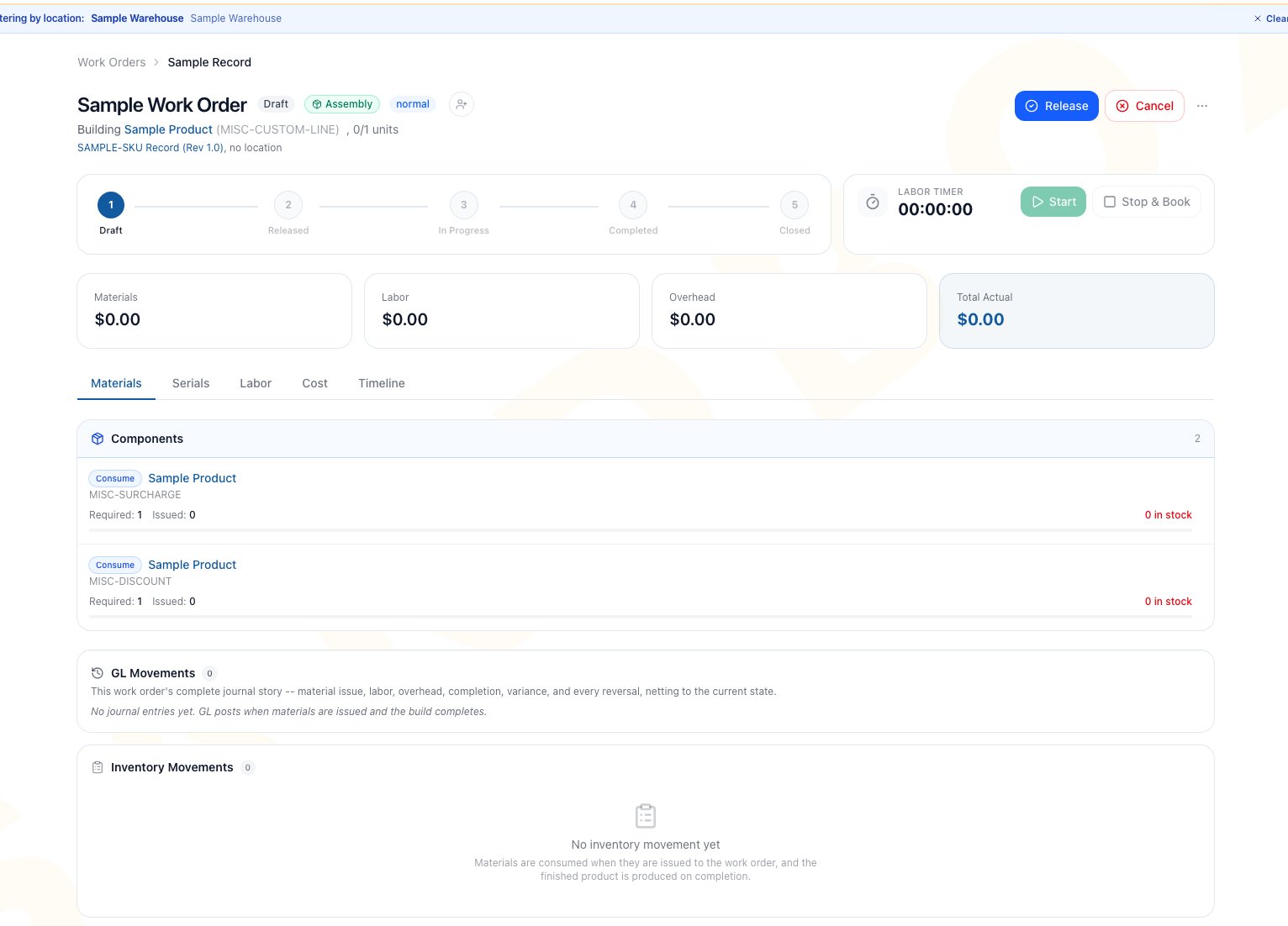
Example Draft Materials tab showing two inputs, required and issued quantities, stock availability, cost cards, and empty movement histories before material is posted.
Choose the correct action
A BOM line marked Retain is informational. A BOM line marked Scrap does not become available stock at completion. These line types do not provide the same buttons as an issued Consume or Add line.
Issue an input
- On a Consume or Add line, click Issue.
- Enter a quantity greater than zero and no more than the displayed remaining quantity.
- Confirm the product, quantity, and available stock.
- Click Issue Material.
- Check Issued, the work-order cost cards, GL Movements, and Inventory Movements.
Outcome
The line’s issued quantity and actual material cost increase. Available stock decreases at the source location or locations, and the related value moves into material WIP.Return an expected recovery
Return applies to a Return to stock line. It is not a way to reverse an issued Consume or Add line.- Click Return on the eligible recovery line.
- Enter a quantity greater than zero and no more than the expected quantity still available to return.
- Confirm the action.
- Put the physical item into the work-order location and follow your warehouse’s normal bin process.
- Verify the returned quantity and Inventory Movements.
Outcome
The line’s returned quantity increases, inventory receives the recovered item at the work-order location, and material WIP is reduced by the recorded return value.Scrap issued material
Use this action only for a Consume or Add quantity that was already issued into WIP and is now unusable.- Click Scrap issued material on the line.
- Enter a quantity no greater than the issued quantity that has not already been scrapped.
- Confirm the reason against the physical material.
- Click the scrap action.
- Review the line, Cost tab, GL Movements, and Inventory Movements.
Outcome
The line’s scrapped quantity increases, actual material cost remaining on the work order decreases, and the value moves from material WIP to scrap expense.Substitute before any issue
Substitution is available only when all of these are true:- The line disposition is Consume or Add.
- The work order is Released or In Progress.
- The line’s issued quantity is exactly zero.
- The line has not already been substituted.
- Click Substitute on the input line.
- Search for the replacement product.
- Select a physical product. The original product, kits, and services are excluded.
- Compare the original and replacement products and the unit-cost change.
- Enter an optional reason.
- Click Substitute.
- If stock is short, review Required and Available. Click Substitute Anyway only when receiving or another supply action will resolve the shortage.
Outcome
The line shows the replacement as a one-time substitution, retains the original product for audit, and shifts future dependent demand to the replacement. Inventory and GL remain unchanged until issue or completion.Common scenario: replace a short component
Suppose an assembly requires 10 units of Component A, no quantity has been issued, and an approved Component B is available.- Confirm with engineering or the recipe owner that Component B is approved.
- Substitute Component B before issuing any material.
- Review the cost change shown in the modal.
- If Arcus warns that Component B is short, do not rely on Substitute Anyway as a supply action. Receive the missing stock first.
- Issue Component B or let completion backflush it.
Let completion backflush remaining inputs
You do not have to issue every Consume or Add line manually. During a partial or full completion, Arcus calculates the cumulative required share and backflushes any remaining quantity needed for that share.- A stock shortage blocks the completion before that completion posts its inventory changes.
- Stock is checked entity-wide and consumed from the work-order location first, then other locations.
- A partial completion consumes only the cumulative share required at that point.
- The final completion catches up the remaining required input.
Review the transaction result
After every material action:- Match the physical quantity and stored result for the action: Issue to Issued, Return to Returned, Scrap to Scrapped, or Substitute to the replacement and original products plus the stored line-cost basis.
- Expand Inventory Movements and confirm product, quantity, and location.
- Expand GL Movements and confirm the related material issue, return, scrap, completion, or reversal entry.
- Review Cost for the updated actual material amount.
- Check Timeline for the acting user and event.
Troubleshoot refusals
Frequently asked questions
Can I substitute after issuing part of a line?
Can I substitute after issuing part of a line?
No. The current workflow requires the line’s issued quantity to be exactly zero. Return or correct the existing material through the approved inventory process before deciding how to continue the work order.
Does Substitute Anyway make stock available?
Does Substitute Anyway make stock available?
No. It records the replacement despite the shortage warning. The work order still needs enough stock before issue or completion.
Why did Issue use stock from another location?
Why did Issue use stock from another location?
Availability and consumption are entity-wide. Arcus prefers the work-order location, then consumes available FIFO layers from other locations. Review Inventory Movements for the exact source locations.
Does Scrap issued material reduce on-hand twice?
Does Scrap issued material reduce on-hand twice?
No. On-hand was reduced at issue. Scrap moves the issued value from material WIP to scrap expense without a second stock consumption.
Related guides
Work Orders
Create, release, start, assign, close, or cancel manufacturing work.
Partial Completions and Undo
Backflush remaining inputs and understand when a completion can be reversed.
Bills of Materials
Define Consume, Add, Return to stock, Scrap, and Retain behavior in the recipe.
Manufacturing Reports
Review open WIP, completion cost, and component usage after posting.