> ## Documentation Index
> Fetch the complete documentation index at: https://docs.arcuserp.com/llms.txt
> Use this file to discover all available pages before exploring further.
# Returns Settings
> Set your company's return policy in one place: the return window and final-sale categories, approval and refund defaults, settlement gates, return labels, fee guardrails, vendor return documents, and serial validation.
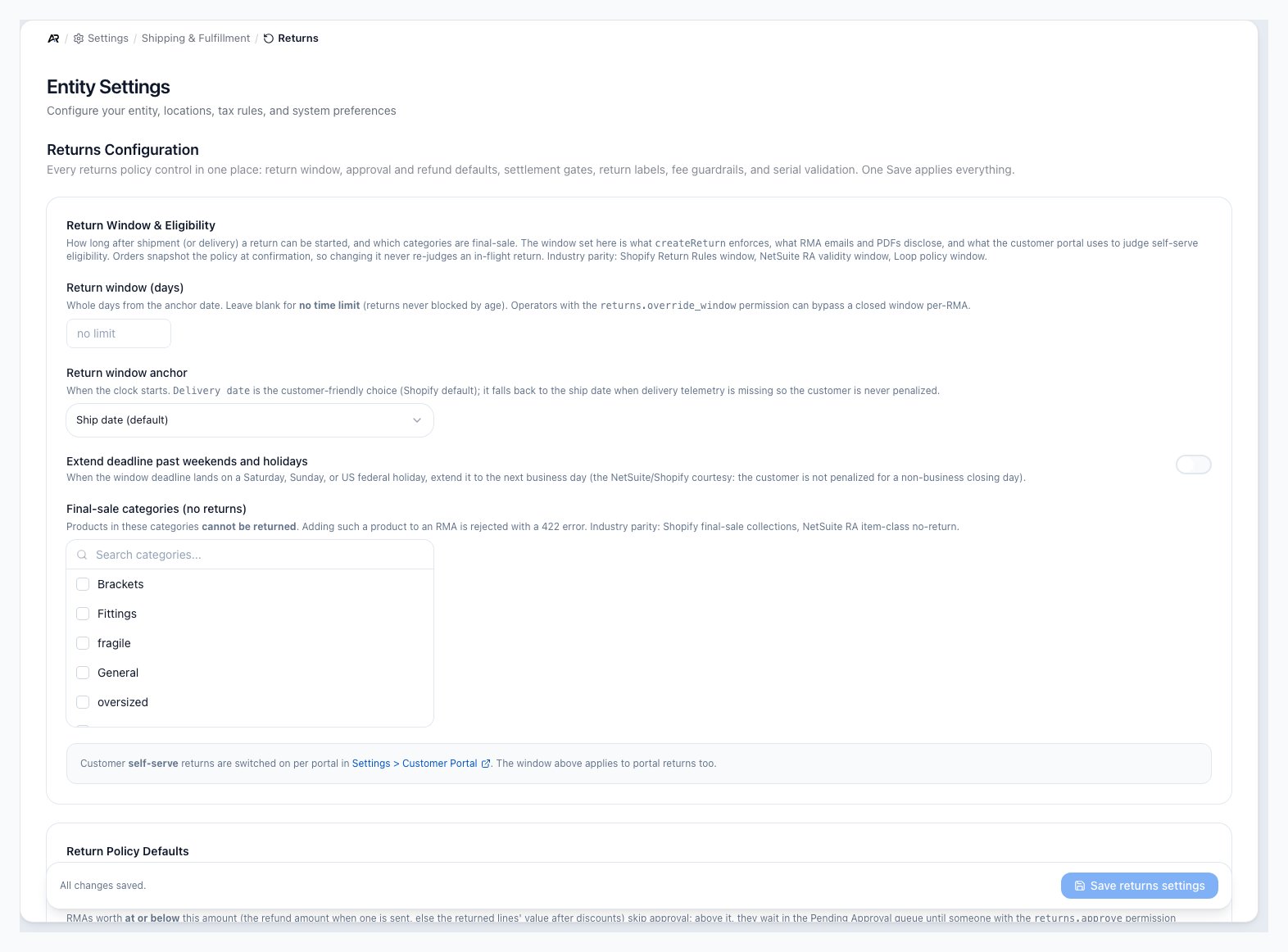
Use the Returns settings page to set the policy every customer return (RMA) follows: how long customers have to start a return, which products are final sale, when a return needs approval, how and when refunds go out, whether return labels are bought for the customer, the outer limits on return fees, and how returned serial numbers are checked. Every returns policy control lives on this one page, and one **Save returns settings** button applies them all.
 Several settings here move money or stock without a person clicking anything: auto-settle timing issues real refunds, a prepaid label policy buys carrier labels, and the stale-RMA sweep voids returns. Review those with whoever owns refunds before you change them.
## Before You Start
* You need the **settings.view** permission to open the page.
* You need **settings.edit** (Edit Settings) to save. The controls show for everyone who can open the page, but without **settings.edit** the save is refused with "Failed to save: Permission denied: settings.edit".
* Product categories should already exist if you plan to mark final-sale categories or route categories to vendor returns.
* Return fee rates themselves are rules on **Settings > Products & Pricing > Adjustments & Coupons**. This page only holds the company-wide limits on them.
## Open Returns Settings
1. In the deck, open **Settings**.
2. Under **Shipping & Fulfillment**, choose **Returns**.
The breadcrumb reads **Settings > Shipping & Fulfillment > Returns**, and the page is titled **Returns Configuration**. You can also search for **Returns** in the command palette. On the Create Return screen, a final-sale line links here ("Final sale policy set in Settings > Returns > Final-sale categories").
## Save Your Changes
Change any fields on the page, then click **Save returns settings** in the bar at the bottom. The bar stays in view as you scroll and tells you where you are:
* "You have unsaved changes." when something changed.
* "Fix the highlighted fields to save." when a field is out of range. The button is disabled with "Fix the highlighted fields first".
* "All changes saved." when nothing is waiting. The button is disabled with "No changes to save".
**Reset** appears while you have unsaved changes and puts every field back to the saved values. When the save works you see "Saved".
## Return Window And Eligibility
* **Return window (days)**: how many whole days after the anchor date a return can be started. Leave it blank for no time limit. Someone with the **returns.override\_window** (Override Return Window) permission can still open a return past a closed window, one RMA at a time.
* **Return window anchor**: when the clock starts. **Ship date (default)**, or **Delivery date (falls back to ship date when delivery is unknown)**, so a customer is never penalized for missing delivery tracking.
* **Extend deadline past weekends and holidays**: off by default. When a deadline lands on a Saturday, Sunday or US federal holiday, it moves to the next business day.
* **Final-sale categories (no returns)**: products in these categories cannot be returned. Adding one to an RMA is refused. Pick categories with the search picker.
The window you set is what new returns are checked against, what return emails and documents state, and what the customer portal uses to decide whether a customer can request a return. Orders keep the policy that applied when they were confirmed, so changing it never re-judges a return already under way. Customer self-serve returns are switched on separately, through the **Settings > Customer Portal** link in this section.
## Return Policy Defaults
* **Auto-approve under \$**: a return worth this amount or less (the refund amount when one is set, otherwise the returned lines' value after discounts) skips approval. A return worth more waits in the Pending Approval queue until someone with the **returns.approve** (Approve Returns) permission approves it. Leave it blank, or enter 0, and no return waits for approval. A warranty replacement that refunds nothing never waits.
* **Auto-void stale authorized RMAs after (days)**: off when blank, which is the default. When set to 1 to 3650 days, a nightly sweep voids any authorized or expected return with nothing received once it is older than that, because the customer never sent the goods back. Voiding reverses everything the return did and releases the authorization; a voided return can be un-voided if the goods arrive later. Migrated historical returns are never auto-voided.
* **Default refund method**: **Auto (decide later)**, **Cash Refund**, **Credit Memo** or **Store Credit**. It is used only when a return arrives without a refund method: a customer portal return request, an eBay return import, or an API call that leaves it out. The method is fixed on the return when it is created. The Create RMA screen does not use this default, because staff choose the outcome there. **Auto** lets the settlement choose from the order's payment state when the return closes.
* **Default disposition after inspection**: pre-fills each line in the **Disposition Items** dialog: **No default (require operator pick)**, **Restock to original location**, **Write off (damaged / defective)** or **Quarantine for inspection**. Staff can change any line. With **No default**, every line starts empty and **Apply Disposition** stays off until each line has a choice.
* **Auto-route to vendor return (categories)**: when a returned item in one of these categories is dispositioned without an explicit choice, Arcus sets it to a vendor return and creates the vendor return for you. Staff can still change it per item.
## Refunds And Settlement
* **Credit-card surcharge on refunds**: what happens to a card processing-fee surcharge when you refund.
* **Refund proportionally (recommended)**, the default: refunds the surcharge in proportion to the amount refunded, which is what the card brands require on a partial refund.
* **Refund only on a full refund**: refunds the whole surcharge only when the entire order is refunded.
* **Never refund the surcharge**: keeps it on every refund. The page warns: "Mastercard requires a proportional surcharge refund on a partial refund."
* **Refund auto-settle timing**: when a refund-eligible return pays out.
* **Manual (operator issues the refund)**, the default: a received return waits in the RMAs Ready for Refund worklist in Accounts Receivable until someone issues the refund.
* **Auto-settle on receive**: the net refund goes back to the original payment method as soon as the return is received.
* **Auto-settle on delivery**: the net refund goes out when the carrier marks the return label delivered. This needs a return label bought through Arcus, so delivery can be tracked.
Auto-settle never pays out on a return that is waiting for approval or on a migrated historical return.
* **Keep-item refund threshold**: when a return's refund is at or below this amount, the Create Return panel suggests refunding without asking for the item back, which saves return freight and handling. Leave it blank to never suggest it.
* **Allow settlement total override**: on by default. A refund total typed on a return is honored at settlement, and the line refunds are scaled to add up to it. Turn it off to allow line-level amounts only.
* **Re-settle pending returns when the invoice posts**: on by default. A return closed before its invoice was posted is settled again when the invoice posts, so the credit lands on the posted invoice. Turn it off to settle those returns by hand.
* **Require disposition before refund**: on by default. A refund cannot be issued while a return is still received or inspecting; someone must decide first whether the goods are restocked, written off or sent to the vendor. **Issue Refund** is disabled with a tooltip until then. Someone with the **returns.override\_condition** (Override Return Condition) permission can override it with a reason, which is audited. Refund-only returns, where no goods come back, are exempt.
## Return Labels
Choose the **Return label policy**:
* **On request (default)**: staff decide per return; a generate-label button appears on the return.
* **Prepaid on authorize**: a prepaid return label can be bought automatically when a return is authorized.
* **Customer self-pays**: Arcus never buys return labels; the customer pays their own postage.
**Auto-generate return label on authorize** works only with **Prepaid on authorize**; otherwise it is disabled with "Select the "Prepaid on authorize" policy above to enable". When it is on, authorizing a return buys a return label through your shipping connection and emails it to the customer.
## Return Processing And Label Defaults
* **Require an inspection step before disposition**: off by default. When on, a received return starts in inspecting, and the dock must finish inspection before it can be restocked, written off or sent to the vendor.
* **Default return carrier** and **Default return service**: filled in on a prepaid return label that is bought automatically on authorize. Enter the carrier and service names your shipping account uses, for example usps and usps\_priority. Leave them blank for none.
## Vendor Returns
These print on the vendor return document when you send goods back to a vendor. An address on the vendor's own account wins over them.
* **RMA "ATTN / care-of" line (optional)**: printed as an ATTN line above the address.
* **Fallback vendor RMA address**: where returned goods ship when the vendor has no return address of its own. When it is blank, the document prints "(Contact vendor for return address)".
* **Vendor-return terms blurb**: replaces the built-in terms paragraph about packing, the vendor's RMA number and the credit window. Leave it blank to use the built-in text.
## Return Fees And Guardrails
Restocking, handling, processing and return-shipping fee rates are rules. The banner "Restocking, handling & processing fees are RULES" explains that you create them on **Settings > Products & Pricing > Adjustments & Coupons** with **Applies to: Returns**; **Open Coupons & Adjustments builder** takes you there. This section keeps only the company-wide limits:
* **Restocking fee bounds (per RMA)**: **Min $** and **Max $**. Whatever restocking rate a rule works out, the fee on one return is kept inside this range, behind any tighter caps on the rule itself. It is checked when the return is created and again at disposition. Leave both blank for no bound.
* **Let AvaTax determine restocking-fee tax**: on by default. The restocking fee is sent to AvaTax, which charges tax only where the customer's state taxes it. Turn it off to never tax restocking fees. A fee rule's own taxable setting wins over this.
* **Let AvaTax determine handling-fee tax**: the same choice for handling fees, on by default.
* **Waive fees on merchant-fault returns**: on by default. Older tier-based restocking and handling fees drop to zero when the return reason is defective, damaged in transit, wrong item shipped, or not as described. Fee rules carry their own waiver checkbox.
If your company still carries an older handling-fee value, the **Legacy entity handling fee (read-only fallback)** box shows it. It applies only when no handling rule matches. **Clear legacy value** marks it to be removed ("Will be cleared when you save."), and **Undo** keeps it. **View per-category legacy rates** opens **Settings > Products & Pricing > Categories**, where older per-category rates are still read as fallbacks.
## Serial Number Validation Mode
When a serialized product is received on a return, Arcus can check that the returned serial number was really shipped on the original order:
* **Off**, the default: any serial number is accepted.
* **Warn**: a warning shows when the serial does not match, and staff can carry on.
* **Hard (Block)**: a serial that does not match is refused until it is corrected.
## Messages You May See
| Message | What it means |
| - | - |
| "Saved" | Your returns settings saved. |
| "Failed to save:" followed by a reason | Nothing was saved. Read the reason, fix it, and save again. |
| "Fix the highlighted fields before saving." | A field is out of range. Look for the red text under it. |
| "Must be a whole number of days (1 or more), or blank." | Fix **Return window (days)**. |
| "Must be a non-negative dollar amount, or blank." | Fix **Auto-approve under \$** or **Keep-item refund threshold**. |
| "Must be a whole number of days between 1 and 3650, or blank to disable." | Fix **Auto-void stale authorized RMAs after (days)**. |
| "Bounds must be non-negative dollar amounts, or blank." | Fix **Min $** or **Max $**. |
| "Minimum must be less than or equal to maximum." | The restocking minimum is above the maximum. |
| "Select "Prepaid on authorize" above to enable this toggle." | Choose **Prepaid on authorize** before turning on automatic labels. |
| "Permission denied: settings.edit" | Your role can view this page but cannot save it. |
| "Entity settings are being updated by another request; retry shortly." | Someone else is saving company settings at the same moment. Try again. |
## What Changes Elsewhere
* **Customer returns**: new returns are checked against the window, the final-sale categories and the approval threshold; existing returns keep the policy their order was confirmed under.
* **Refunds and the general ledger**: auto-settle timing issues real refunds to the customer's original payment method and records them, and the surcharge policy decides how much of a card surcharge goes back.
* **Inventory**: the default disposition, the inspection step and the auto-route categories decide how returned stock is restocked, written off or sent back to the vendor.
* **Carrier labels and customer email**: with **Prepaid on authorize** and the automatic toggle on, each authorized return buys a carrier label and emails it to the customer.
* **Sales tax**: restocking and handling fees are taxed through AvaTax unless you turn that off.
* **Nightly sweep**: with a stale-RMA limit set, old returns with nothing received are voided each night.
* **Vendor return documents**: the ATTN line, fallback address and terms print on vendor return documents.
* **Customer portal**: portal return requests use the window and the default refund method.
* **Audit trail**: each save is recorded in the Audit Log with the old and new values, and other people with Settings open see the change without reloading.
## Common Blocks
* **A customer cannot start a return**: check the return window, the anchor date and whether the product is in a final-sale category.
* **A return is stuck in Pending Approval**: its value is above **Auto-approve under \$**. Someone with **Approve Returns** must approve it.
* **Issue Refund is disabled on a received return**: **Require disposition before refund** is on. Disposition the return first, or have someone with **returns.override\_condition** override it.
* **A refund went out without anyone clicking**: **Refund auto-settle timing** is set to receive or delivery.
* **No return label was bought on authorize**: the policy must be **Prepaid on authorize** and **Auto-generate return label on authorize** must be on.
* **The Save button stays grey**: nothing changed, or a field is highlighted in red.
## Related Articles
Work the returns list, approvals, receiving, inspection, disposition and refunds.
Start a return for an order's lines and choose what the customer gets.
Send goods back to a vendor with the document and label this page configures.
Turn on customer self-serve return requests in the portal.
Create the restocking, handling and processing fee rules this page limits.
Set vendor return defaults on Vendor Return Policy.
This documentation is built and hosted on [Mintlify](https://mintlify.com), a developer documentation platform.
Several settings here move money or stock without a person clicking anything: auto-settle timing issues real refunds, a prepaid label policy buys carrier labels, and the stale-RMA sweep voids returns. Review those with whoever owns refunds before you change them.
## Before You Start
* You need the **settings.view** permission to open the page.
* You need **settings.edit** (Edit Settings) to save. The controls show for everyone who can open the page, but without **settings.edit** the save is refused with "Failed to save: Permission denied: settings.edit".
* Product categories should already exist if you plan to mark final-sale categories or route categories to vendor returns.
* Return fee rates themselves are rules on **Settings > Products & Pricing > Adjustments & Coupons**. This page only holds the company-wide limits on them.
## Open Returns Settings
1. In the deck, open **Settings**.
2. Under **Shipping & Fulfillment**, choose **Returns**.
The breadcrumb reads **Settings > Shipping & Fulfillment > Returns**, and the page is titled **Returns Configuration**. You can also search for **Returns** in the command palette. On the Create Return screen, a final-sale line links here ("Final sale policy set in Settings > Returns > Final-sale categories").
## Save Your Changes
Change any fields on the page, then click **Save returns settings** in the bar at the bottom. The bar stays in view as you scroll and tells you where you are:
* "You have unsaved changes." when something changed.
* "Fix the highlighted fields to save." when a field is out of range. The button is disabled with "Fix the highlighted fields first".
* "All changes saved." when nothing is waiting. The button is disabled with "No changes to save".
**Reset** appears while you have unsaved changes and puts every field back to the saved values. When the save works you see "Saved".
## Return Window And Eligibility
* **Return window (days)**: how many whole days after the anchor date a return can be started. Leave it blank for no time limit. Someone with the **returns.override\_window** (Override Return Window) permission can still open a return past a closed window, one RMA at a time.
* **Return window anchor**: when the clock starts. **Ship date (default)**, or **Delivery date (falls back to ship date when delivery is unknown)**, so a customer is never penalized for missing delivery tracking.
* **Extend deadline past weekends and holidays**: off by default. When a deadline lands on a Saturday, Sunday or US federal holiday, it moves to the next business day.
* **Final-sale categories (no returns)**: products in these categories cannot be returned. Adding one to an RMA is refused. Pick categories with the search picker.
The window you set is what new returns are checked against, what return emails and documents state, and what the customer portal uses to decide whether a customer can request a return. Orders keep the policy that applied when they were confirmed, so changing it never re-judges a return already under way. Customer self-serve returns are switched on separately, through the **Settings > Customer Portal** link in this section.
## Return Policy Defaults
* **Auto-approve under \$**: a return worth this amount or less (the refund amount when one is set, otherwise the returned lines' value after discounts) skips approval. A return worth more waits in the Pending Approval queue until someone with the **returns.approve** (Approve Returns) permission approves it. Leave it blank, or enter 0, and no return waits for approval. A warranty replacement that refunds nothing never waits.
* **Auto-void stale authorized RMAs after (days)**: off when blank, which is the default. When set to 1 to 3650 days, a nightly sweep voids any authorized or expected return with nothing received once it is older than that, because the customer never sent the goods back. Voiding reverses everything the return did and releases the authorization; a voided return can be un-voided if the goods arrive later. Migrated historical returns are never auto-voided.
* **Default refund method**: **Auto (decide later)**, **Cash Refund**, **Credit Memo** or **Store Credit**. It is used only when a return arrives without a refund method: a customer portal return request, an eBay return import, or an API call that leaves it out. The method is fixed on the return when it is created. The Create RMA screen does not use this default, because staff choose the outcome there. **Auto** lets the settlement choose from the order's payment state when the return closes.
* **Default disposition after inspection**: pre-fills each line in the **Disposition Items** dialog: **No default (require operator pick)**, **Restock to original location**, **Write off (damaged / defective)** or **Quarantine for inspection**. Staff can change any line. With **No default**, every line starts empty and **Apply Disposition** stays off until each line has a choice.
* **Auto-route to vendor return (categories)**: when a returned item in one of these categories is dispositioned without an explicit choice, Arcus sets it to a vendor return and creates the vendor return for you. Staff can still change it per item.
## Refunds And Settlement
* **Credit-card surcharge on refunds**: what happens to a card processing-fee surcharge when you refund.
* **Refund proportionally (recommended)**, the default: refunds the surcharge in proportion to the amount refunded, which is what the card brands require on a partial refund.
* **Refund only on a full refund**: refunds the whole surcharge only when the entire order is refunded.
* **Never refund the surcharge**: keeps it on every refund. The page warns: "Mastercard requires a proportional surcharge refund on a partial refund."
* **Refund auto-settle timing**: when a refund-eligible return pays out.
* **Manual (operator issues the refund)**, the default: a received return waits in the RMAs Ready for Refund worklist in Accounts Receivable until someone issues the refund.
* **Auto-settle on receive**: the net refund goes back to the original payment method as soon as the return is received.
* **Auto-settle on delivery**: the net refund goes out when the carrier marks the return label delivered. This needs a return label bought through Arcus, so delivery can be tracked.
Auto-settle never pays out on a return that is waiting for approval or on a migrated historical return.
* **Keep-item refund threshold**: when a return's refund is at or below this amount, the Create Return panel suggests refunding without asking for the item back, which saves return freight and handling. Leave it blank to never suggest it.
* **Allow settlement total override**: on by default. A refund total typed on a return is honored at settlement, and the line refunds are scaled to add up to it. Turn it off to allow line-level amounts only.
* **Re-settle pending returns when the invoice posts**: on by default. A return closed before its invoice was posted is settled again when the invoice posts, so the credit lands on the posted invoice. Turn it off to settle those returns by hand.
* **Require disposition before refund**: on by default. A refund cannot be issued while a return is still received or inspecting; someone must decide first whether the goods are restocked, written off or sent to the vendor. **Issue Refund** is disabled with a tooltip until then. Someone with the **returns.override\_condition** (Override Return Condition) permission can override it with a reason, which is audited. Refund-only returns, where no goods come back, are exempt.
## Return Labels
Choose the **Return label policy**:
* **On request (default)**: staff decide per return; a generate-label button appears on the return.
* **Prepaid on authorize**: a prepaid return label can be bought automatically when a return is authorized.
* **Customer self-pays**: Arcus never buys return labels; the customer pays their own postage.
**Auto-generate return label on authorize** works only with **Prepaid on authorize**; otherwise it is disabled with "Select the "Prepaid on authorize" policy above to enable". When it is on, authorizing a return buys a return label through your shipping connection and emails it to the customer.
## Return Processing And Label Defaults
* **Require an inspection step before disposition**: off by default. When on, a received return starts in inspecting, and the dock must finish inspection before it can be restocked, written off or sent to the vendor.
* **Default return carrier** and **Default return service**: filled in on a prepaid return label that is bought automatically on authorize. Enter the carrier and service names your shipping account uses, for example usps and usps\_priority. Leave them blank for none.
## Vendor Returns
These print on the vendor return document when you send goods back to a vendor. An address on the vendor's own account wins over them.
* **RMA "ATTN / care-of" line (optional)**: printed as an ATTN line above the address.
* **Fallback vendor RMA address**: where returned goods ship when the vendor has no return address of its own. When it is blank, the document prints "(Contact vendor for return address)".
* **Vendor-return terms blurb**: replaces the built-in terms paragraph about packing, the vendor's RMA number and the credit window. Leave it blank to use the built-in text.
## Return Fees And Guardrails
Restocking, handling, processing and return-shipping fee rates are rules. The banner "Restocking, handling & processing fees are RULES" explains that you create them on **Settings > Products & Pricing > Adjustments & Coupons** with **Applies to: Returns**; **Open Coupons & Adjustments builder** takes you there. This section keeps only the company-wide limits:
* **Restocking fee bounds (per RMA)**: **Min $** and **Max $**. Whatever restocking rate a rule works out, the fee on one return is kept inside this range, behind any tighter caps on the rule itself. It is checked when the return is created and again at disposition. Leave both blank for no bound.
* **Let AvaTax determine restocking-fee tax**: on by default. The restocking fee is sent to AvaTax, which charges tax only where the customer's state taxes it. Turn it off to never tax restocking fees. A fee rule's own taxable setting wins over this.
* **Let AvaTax determine handling-fee tax**: the same choice for handling fees, on by default.
* **Waive fees on merchant-fault returns**: on by default. Older tier-based restocking and handling fees drop to zero when the return reason is defective, damaged in transit, wrong item shipped, or not as described. Fee rules carry their own waiver checkbox.
If your company still carries an older handling-fee value, the **Legacy entity handling fee (read-only fallback)** box shows it. It applies only when no handling rule matches. **Clear legacy value** marks it to be removed ("Will be cleared when you save."), and **Undo** keeps it. **View per-category legacy rates** opens **Settings > Products & Pricing > Categories**, where older per-category rates are still read as fallbacks.
## Serial Number Validation Mode
When a serialized product is received on a return, Arcus can check that the returned serial number was really shipped on the original order:
* **Off**, the default: any serial number is accepted.
* **Warn**: a warning shows when the serial does not match, and staff can carry on.
* **Hard (Block)**: a serial that does not match is refused until it is corrected.
## Messages You May See
| Message | What it means |
| - | - |
| "Saved" | Your returns settings saved. |
| "Failed to save:" followed by a reason | Nothing was saved. Read the reason, fix it, and save again. |
| "Fix the highlighted fields before saving." | A field is out of range. Look for the red text under it. |
| "Must be a whole number of days (1 or more), or blank." | Fix **Return window (days)**. |
| "Must be a non-negative dollar amount, or blank." | Fix **Auto-approve under \$** or **Keep-item refund threshold**. |
| "Must be a whole number of days between 1 and 3650, or blank to disable." | Fix **Auto-void stale authorized RMAs after (days)**. |
| "Bounds must be non-negative dollar amounts, or blank." | Fix **Min $** or **Max $**. |
| "Minimum must be less than or equal to maximum." | The restocking minimum is above the maximum. |
| "Select "Prepaid on authorize" above to enable this toggle." | Choose **Prepaid on authorize** before turning on automatic labels. |
| "Permission denied: settings.edit" | Your role can view this page but cannot save it. |
| "Entity settings are being updated by another request; retry shortly." | Someone else is saving company settings at the same moment. Try again. |
## What Changes Elsewhere
* **Customer returns**: new returns are checked against the window, the final-sale categories and the approval threshold; existing returns keep the policy their order was confirmed under.
* **Refunds and the general ledger**: auto-settle timing issues real refunds to the customer's original payment method and records them, and the surcharge policy decides how much of a card surcharge goes back.
* **Inventory**: the default disposition, the inspection step and the auto-route categories decide how returned stock is restocked, written off or sent back to the vendor.
* **Carrier labels and customer email**: with **Prepaid on authorize** and the automatic toggle on, each authorized return buys a carrier label and emails it to the customer.
* **Sales tax**: restocking and handling fees are taxed through AvaTax unless you turn that off.
* **Nightly sweep**: with a stale-RMA limit set, old returns with nothing received are voided each night.
* **Vendor return documents**: the ATTN line, fallback address and terms print on vendor return documents.
* **Customer portal**: portal return requests use the window and the default refund method.
* **Audit trail**: each save is recorded in the Audit Log with the old and new values, and other people with Settings open see the change without reloading.
## Common Blocks
* **A customer cannot start a return**: check the return window, the anchor date and whether the product is in a final-sale category.
* **A return is stuck in Pending Approval**: its value is above **Auto-approve under \$**. Someone with **Approve Returns** must approve it.
* **Issue Refund is disabled on a received return**: **Require disposition before refund** is on. Disposition the return first, or have someone with **returns.override\_condition** override it.
* **A refund went out without anyone clicking**: **Refund auto-settle timing** is set to receive or delivery.
* **No return label was bought on authorize**: the policy must be **Prepaid on authorize** and **Auto-generate return label on authorize** must be on.
* **The Save button stays grey**: nothing changed, or a field is highlighted in red.
## Related Articles
Work the returns list, approvals, receiving, inspection, disposition and refunds.
Start a return for an order's lines and choose what the customer gets.
Send goods back to a vendor with the document and label this page configures.
Turn on customer self-serve return requests in the portal.
Create the restocking, handling and processing fee rules this page limits.
Set vendor return defaults on Vendor Return Policy.
This documentation is built and hosted on [Mintlify](https://mintlify.com), a developer documentation platform.