> ## Documentation Index
> Fetch the complete documentation index at: https://docs.arcuserp.com/llms.txt
> Use this file to discover all available pages before exploring further.
# Create A Bill Of Materials
> Create an assembly, disassembly, or conversion BOM, add material lines, plan labor, and activate a verified recipe.
Create a BOM when Arcus needs a controlled recipe for repeatable assembly, teardown, or conversion work. Every new BOM starts as a Draft so you can verify its materials, cost plan, and operating instructions before production uses it.
Open **Manufacturing > Bills of Materials** and click **New BOM**. You need **manufacturing.view** to open BOM pages, **manufacturing.create** to create the Draft, and **manufacturing.edit** to add lines and activate it.
## Before You Start
Confirm these decisions outside the modal:
* The eligible specific product or SKU being built, disassembled, or produced by conversion.
* For a conversion, the eligible specific **Source Product** being transformed.
* The physical quantity handled or produced by one run.
* The materials and disposition of every line.
* Whether the entity's configured default overhead is appropriate for this new recipe.
* The planned labor time, rate, and auto-book decision.
* Whether an assembly is an MRP-only phantom subassembly.
Kits, services, variant-parent shells, and box packaging records are refused in BOM product choices. A product being selectable does not by itself mean it is active, inventory tracked, or ready for MRP.
Choose the source, output, output quantity, and required overhead carefully. The current BOM detail page does not provide controls to edit source product, output product, output quantity, or overhead after creation.
## 1. Create The Draft Header
1. Click **New BOM**.
2. Select **Assembly**, **Disassembly**, or **Conversion**.
3. Enter a name that tells planners which physical process this recipe represents.
4. Complete the type-specific product field:
* Assembly: **Product to Build**
* Disassembly: **Product to Disassemble**
* Conversion: **Output Product** and **Source Product**
5. Enter **Output Quantity per Run**.
6. Click **Create BOM**.
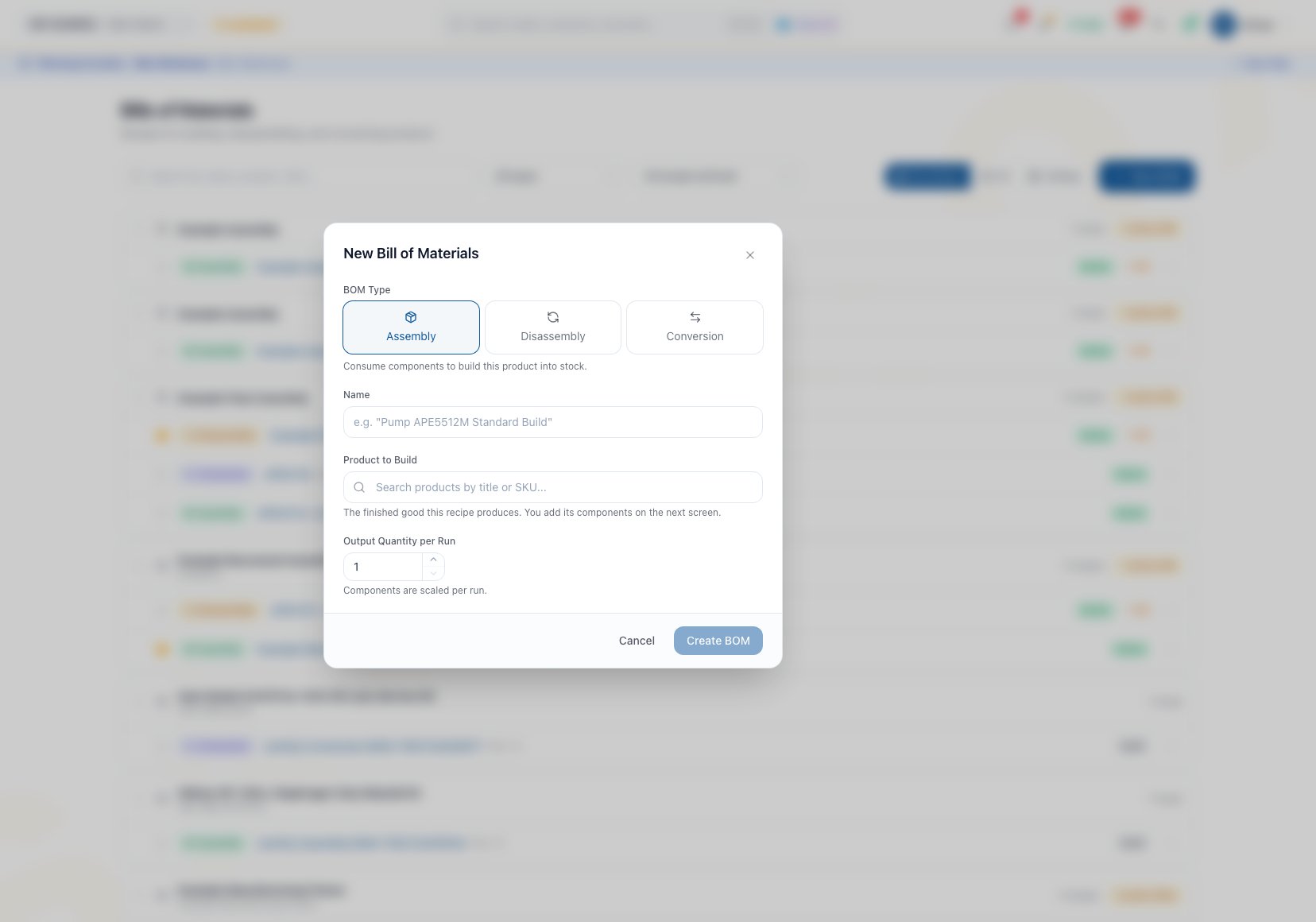 Arcus opens the new recipe as **Draft**. Output quantity describes a whole run. If one run builds six finished units, enter material quantities for that whole six-unit run.
**Outcome:** The Draft header exists, but it is not ready for production or MRP until lines are added, the recipe is reviewed, and it is activated. Creating the Draft does not move inventory or post an accounting entry.
The new recipe starts as revision **1.0**. The creation modal does not ask for a revision label; later controlled changes use **Revise** from an approved recipe.
## 2. Add Material Lines
1. In the recipe's **Flat** view, click **Add Component**.
2. Select the eligible specific product or SKU.
3. Enter **Quantity per Run**.
4. Choose an available **Disposition**.
5. Add optional floor instructions for that line.
6. Click **Add**.
7. Repeat until the physical recipe is complete.
Arcus opens the new recipe as **Draft**. Output quantity describes a whole run. If one run builds six finished units, enter material quantities for that whole six-unit run.
**Outcome:** The Draft header exists, but it is not ready for production or MRP until lines are added, the recipe is reviewed, and it is activated. Creating the Draft does not move inventory or post an accounting entry.
The new recipe starts as revision **1.0**. The creation modal does not ask for a revision label; later controlled changes use **Revise** from an approved recipe.
## 2. Add Material Lines
1. In the recipe's **Flat** view, click **Add Component**.
2. Select the eligible specific product or SKU.
3. Enter **Quantity per Run**.
4. Choose an available **Disposition**.
5. Add optional floor instructions for that line.
6. Click **Add**.
7. Repeat until the physical recipe is complete.
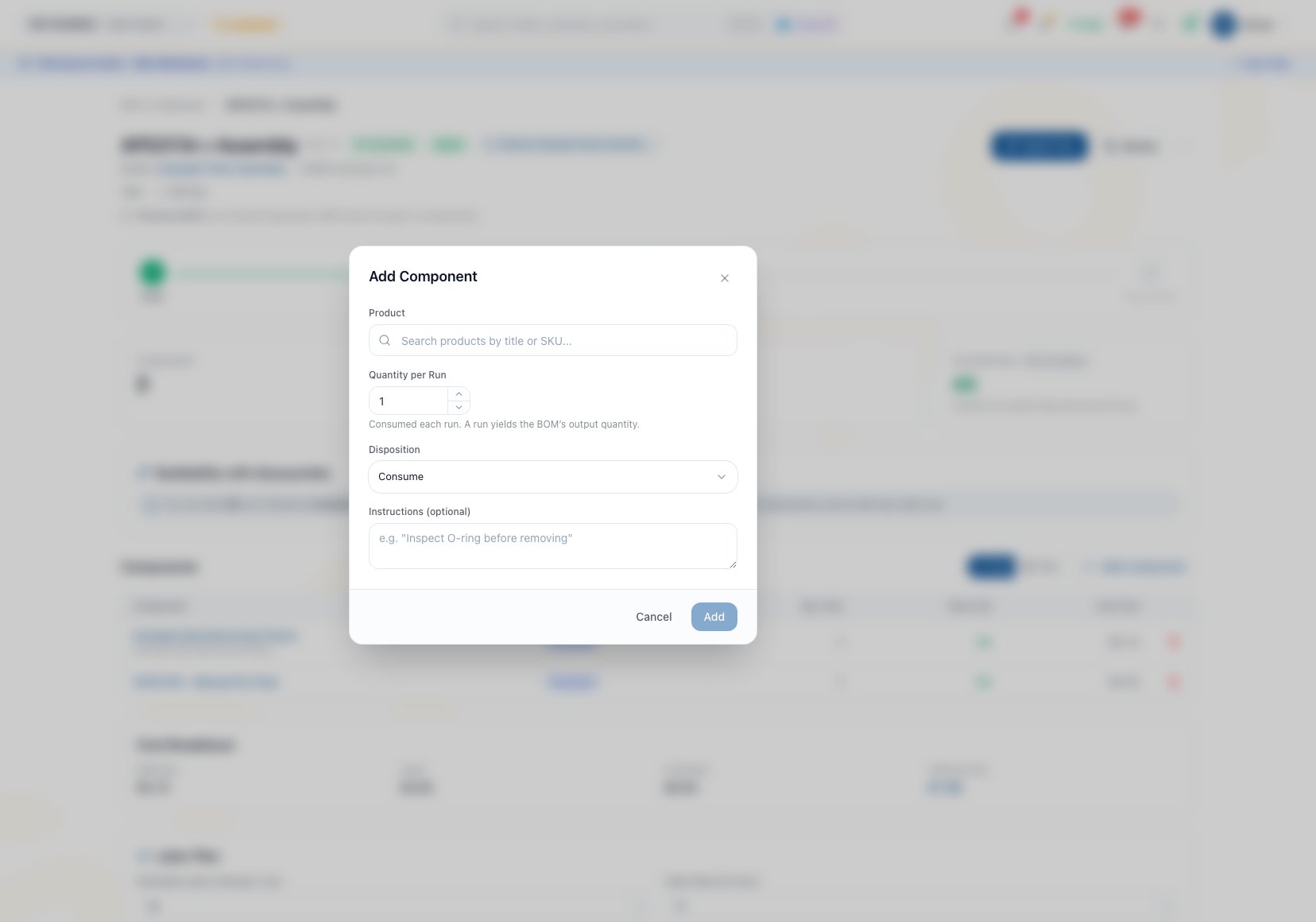 The type controls the available dispositions:
| BOM type | Available dispositions |
| ----------- | ---------------------------------------------------------------- |
| Assembly | **Consume** |
| Disassembly | **Return to stock**, **Scrap** |
| Conversion | **Consume**, **Add**, **Return to stock**, **Scrap**, **Retain** |
Adding the same product and variant again updates that existing line and adds the new quantity to it. It does not create a second independent row, and it keeps the existing line's first disposition. Do not try to model one item in multiple dispositions by adding it again. Check the resulting total and retained disposition before continuing.
Use [Disassembly And Conversion](/support/manufacturing/disassembly-and-conversion) before choosing teardown or conversion dispositions. **Add** and **Consume** currently share the same material and accounting treatment: both pull the line from inventory into work-order material cost. The distinction records floor intent, not a different cost path.
### Correct A Material Line
The current component table does not provide a complete inline editor for product, quantity, disposition, or instruction. On a Draft:
1. Click **Remove** on the incorrect line.
2. Click **Add Component**.
3. Re-enter the correct product, quantity per run, disposition, and instruction.
4. Verify the resulting line and cost.
Do not re-add the same product when you intend to replace its quantity. That action sums onto the existing quantity. Disassembly **Cost %** is the exception: it has its own editable control on Return to stock lines.
Once a recipe is Active, create a revision for a physical recipe change instead of silently rewriting the current process. Existing work orders keep their own material snapshot, while the revision preserves a clear before-and-after recipe history.
## 3. Review Labor, Cost, And Instructions
1. Enter estimated labor minutes per run and the planned hourly rate.
2. Turn on **Auto-book labor** only when completion should book that planned labor automatically.
3. Review material, labor, and overhead in the cost summary.
4. Confirm every component quantity and instruction.
5. Attach the controlled SOP, drawing, or specification in **Documents**.
Material estimates use current recorded product or variant cost, not list price. They can change when product costs change. Actual work-order cost can differ because inventory issues, substitutions, scrap, partial completion, and recorded labor occur later.
Do not time the same labor and auto-book it unless double booking is intentional. See [Manufacturing Settings](/support/manufacturing/settings) before creating the BOM when the entity's labor or default overhead setup is uncertain.
## 4. Set Assembly-Only Phantom Behavior
Use **Phantom BOM** only on an assembly that should disappear as an intermediate level during MRP explosion. MRP then plans its leaf components instead of emitting the phantom product as a separate requirement.
Phantom status does not move inventory, create work orders, or make a Draft usable. It affects MRP only. It also does not carry forward automatically when a revision is created.
## 5. Verify And Activate
Use this final gate:
* Type, source, output, and output quantity describe the physical job.
* At least one total material line exists. On the current BOM page, **Activate** remains unavailable with no lines, including for a Conversion. This is a page control, not a two-line conversion rule.
* Quantities are per run, not accidentally per finished unit.
* Each disposition matches the floor outcome.
* Disassembly return-cost percentages are valid.
* Labor and auto-book choices cannot double count normal work.
* Cost and entity-wide availability have been reviewed.
* Current instructions are attached.
* Phantom is used only for an intentional assembly planning level.
Click **Activate**, then verify the **Active** status.
**Outcome:** Authorized users can open the BOM and use **Build This**, **Disassemble**, or **Convert**. Activation does not move inventory, post an accounting entry, or make the BOM the product default. Set a default separately only after the recipe is approved for MRP.
## Common Scenario: A Four-Unit Assembly Run
A production cell builds four finished units each cycle.
1. Create an Assembly BOM with **Output Quantity per Run** set to 4.
2. Enter each component's total quantity for the four-unit cycle.
3. Add the cell setup instruction to the relevant component or attach the current SOP.
4. Enter labor for the whole run.
5. Review **Can Build Now** as finished output, not as run count.
6. Activate only after a second reviewer confirms the per-run math.
If one component is entered per finished unit instead of per run, the work order will understate material requirements.
## Troubleshooting And Refusals
* **Create BOM is unavailable**: Confirm you have create permission.
* **Create BOM stays disabled**: Enter a name, select the required product, and for Conversion select both output and source products.
* **A product is missing**: Select an eligible specific product or variant. Unsupported product types are intentionally excluded.
* **Activate is unavailable**: On the BOM page, add at least one material line and confirm you have edit permission.
* **A duplicate component changed the quantity**: Arcus combines the quantity with the existing product and variant line and retains that line's first disposition. Remove and re-add the line when the physical disposition is wrong; do not add the same item again to represent a second outcome.
* **The wrong source, output, quantity, or overhead was saved**: Do not activate the recipe. Create a correct Draft because those fields are not currently editable on the detail page.
* **Cost looks unexpected**: Check current recorded component costs, labor, overhead configuration, return-cost allocation, and quantity-per-run math.
* **The action still does not appear after creation**: The BOM must be Active, and the user needs create permission for production work.
## FAQ
Draft keeps an incomplete recipe out of normal production and MRP while materials, quantities, cost, labor, and instructions are reviewed.
Not from the current BOM detail page. If it is wrong, create a correct Draft and retire the mistaken unused recipe through the normal lifecycle.
No. They are per run. Compare every line to **Output Quantity per Run** before activation.
No. Status and default are separate. Set the approved Active recipe as default only when MRP should normally use it.
## Related Guides
Choose the recipe type and find the correct product revision.
Plan source products, dispositions, recovery cost, and conversion outcomes.
Attach the work instructions and specifications operators need.
Activate, revise, compare, default, archive, delete, and restore recipes.
Check current availability before creating production work.
Turn an Active BOM into controlled floor work.
The type controls the available dispositions:
| BOM type | Available dispositions |
| ----------- | ---------------------------------------------------------------- |
| Assembly | **Consume** |
| Disassembly | **Return to stock**, **Scrap** |
| Conversion | **Consume**, **Add**, **Return to stock**, **Scrap**, **Retain** |
Adding the same product and variant again updates that existing line and adds the new quantity to it. It does not create a second independent row, and it keeps the existing line's first disposition. Do not try to model one item in multiple dispositions by adding it again. Check the resulting total and retained disposition before continuing.
Use [Disassembly And Conversion](/support/manufacturing/disassembly-and-conversion) before choosing teardown or conversion dispositions. **Add** and **Consume** currently share the same material and accounting treatment: both pull the line from inventory into work-order material cost. The distinction records floor intent, not a different cost path.
### Correct A Material Line
The current component table does not provide a complete inline editor for product, quantity, disposition, or instruction. On a Draft:
1. Click **Remove** on the incorrect line.
2. Click **Add Component**.
3. Re-enter the correct product, quantity per run, disposition, and instruction.
4. Verify the resulting line and cost.
Do not re-add the same product when you intend to replace its quantity. That action sums onto the existing quantity. Disassembly **Cost %** is the exception: it has its own editable control on Return to stock lines.
Once a recipe is Active, create a revision for a physical recipe change instead of silently rewriting the current process. Existing work orders keep their own material snapshot, while the revision preserves a clear before-and-after recipe history.
## 3. Review Labor, Cost, And Instructions
1. Enter estimated labor minutes per run and the planned hourly rate.
2. Turn on **Auto-book labor** only when completion should book that planned labor automatically.
3. Review material, labor, and overhead in the cost summary.
4. Confirm every component quantity and instruction.
5. Attach the controlled SOP, drawing, or specification in **Documents**.
Material estimates use current recorded product or variant cost, not list price. They can change when product costs change. Actual work-order cost can differ because inventory issues, substitutions, scrap, partial completion, and recorded labor occur later.
Do not time the same labor and auto-book it unless double booking is intentional. See [Manufacturing Settings](/support/manufacturing/settings) before creating the BOM when the entity's labor or default overhead setup is uncertain.
## 4. Set Assembly-Only Phantom Behavior
Use **Phantom BOM** only on an assembly that should disappear as an intermediate level during MRP explosion. MRP then plans its leaf components instead of emitting the phantom product as a separate requirement.
Phantom status does not move inventory, create work orders, or make a Draft usable. It affects MRP only. It also does not carry forward automatically when a revision is created.
## 5. Verify And Activate
Use this final gate:
* Type, source, output, and output quantity describe the physical job.
* At least one total material line exists. On the current BOM page, **Activate** remains unavailable with no lines, including for a Conversion. This is a page control, not a two-line conversion rule.
* Quantities are per run, not accidentally per finished unit.
* Each disposition matches the floor outcome.
* Disassembly return-cost percentages are valid.
* Labor and auto-book choices cannot double count normal work.
* Cost and entity-wide availability have been reviewed.
* Current instructions are attached.
* Phantom is used only for an intentional assembly planning level.
Click **Activate**, then verify the **Active** status.
**Outcome:** Authorized users can open the BOM and use **Build This**, **Disassemble**, or **Convert**. Activation does not move inventory, post an accounting entry, or make the BOM the product default. Set a default separately only after the recipe is approved for MRP.
## Common Scenario: A Four-Unit Assembly Run
A production cell builds four finished units each cycle.
1. Create an Assembly BOM with **Output Quantity per Run** set to 4.
2. Enter each component's total quantity for the four-unit cycle.
3. Add the cell setup instruction to the relevant component or attach the current SOP.
4. Enter labor for the whole run.
5. Review **Can Build Now** as finished output, not as run count.
6. Activate only after a second reviewer confirms the per-run math.
If one component is entered per finished unit instead of per run, the work order will understate material requirements.
## Troubleshooting And Refusals
* **Create BOM is unavailable**: Confirm you have create permission.
* **Create BOM stays disabled**: Enter a name, select the required product, and for Conversion select both output and source products.
* **A product is missing**: Select an eligible specific product or variant. Unsupported product types are intentionally excluded.
* **Activate is unavailable**: On the BOM page, add at least one material line and confirm you have edit permission.
* **A duplicate component changed the quantity**: Arcus combines the quantity with the existing product and variant line and retains that line's first disposition. Remove and re-add the line when the physical disposition is wrong; do not add the same item again to represent a second outcome.
* **The wrong source, output, quantity, or overhead was saved**: Do not activate the recipe. Create a correct Draft because those fields are not currently editable on the detail page.
* **Cost looks unexpected**: Check current recorded component costs, labor, overhead configuration, return-cost allocation, and quantity-per-run math.
* **The action still does not appear after creation**: The BOM must be Active, and the user needs create permission for production work.
## FAQ
Draft keeps an incomplete recipe out of normal production and MRP while materials, quantities, cost, labor, and instructions are reviewed.
Not from the current BOM detail page. If it is wrong, create a correct Draft and retire the mistaken unused recipe through the normal lifecycle.
No. They are per run. Compare every line to **Output Quantity per Run** before activation.
No. Status and default are separate. Set the approved Active recipe as default only when MRP should normally use it.
## Related Guides
Choose the recipe type and find the correct product revision.
Plan source products, dispositions, recovery cost, and conversion outcomes.
Attach the work instructions and specifications operators need.
Activate, revise, compare, default, archive, delete, and restore recipes.
Check current availability before creating production work.
Turn an Active BOM into controlled floor work.