> ## Documentation Index
> Fetch the complete documentation index at: https://docs.arcuserp.com/llms.txt
> Use this file to discover all available pages before exploring further.
# Bill Dates and GL Posting
> A vendor bill carries a bill date, an effective date and a due date. The effective date is the posting date: it decides which accounting period the bill's ledger entries land in. Learn where each date comes from, what the posting window and closed periods allow, how to move a posted bill, and which reports follow it.
A vendor bill carries three dates, and each does a different job. The **effective date** is the one
that reaches your books: it is the date the bill posts to the general ledger (GL), so it decides
which accounting period the bill's entries land in. Read this page when a bill shows up in the wrong
month, when you need to book a bill into a month other than today's, or when Arcus refuses a date
and you want to know why.
Some bills sit on a date other than their effective date. A recurring or lease bill whose date is not
allowed posts on the day it is created instead. A bill posted before October 6, 2026 posted on its
bill date (on the day it posted, when the bill date was still ahead), whatever its effective date
said, and it stays there until you move it. The **Bill Summary** on the bill shows **Posted to GL on
(date)** under **Effective date**, with a line saying why when Arcus can tell.
## The Three Dates
| Date | What it is | Where it comes from | What follows it |
| - | - | - | - |
| **Bill date** | The date on the vendor's invoice. Every bill has one. | You enter it, or the work that created the bill supplies it (see the next section). | The **Date** column and date range on the AP Bills list, the **Transactions** tab on the vendor's account (it lists each bill on its bill date, runs the balance in that order and filters by it), the **Last Bill** column on the Vendor tab, the dashboard's **Top Vendors** and spend Pareto, the early-payment discount deadline, the acquisition date of a fixed asset Arcus creates from the bill, and the date range of the public API's vendor bill search. |
| **Effective date** | The posting date: the day the bill posts to the GL. | You enter it, or the work that created the bill supplies it (see the next section). Left blank, it is the bill date. | Every entry the bill posts: the payable and the expense or inventory side, and any revaluation, landed-cost or write-off entry. So the accounting period, and the reports under [Reports That Follow The Posting Date](#reports-that-follow-the-posting-date). |
| **Due date** | When the vendor expects payment. | Arcus adds the payment terms' days to the effective date, or to the bill date when there is no effective date. A due date you type is kept. | The **Overdue** tab and the days overdue in AP aging. |
A payment has its own date too, picked when you pay. It is not one of the bill's three dates (see
[What Is Not A Posting Date](#what-is-not-a-posting-date)).
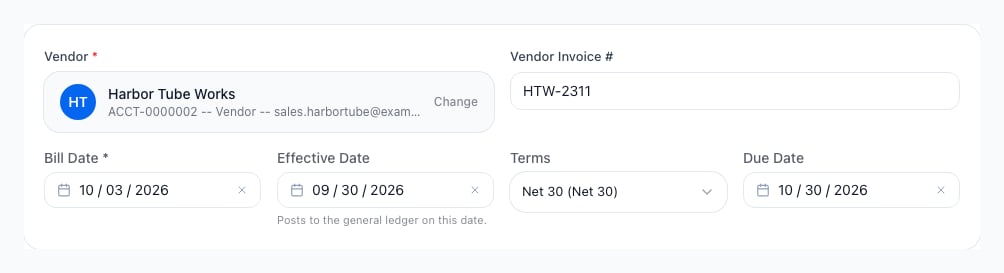
Most of the time the dates agree: you enter the invoice date, leave **Effective Date** blank, and the
bill posts on it. Set an effective date when the books should show a bill in a different month from its
invoice. For example, a freight statement dated October 3 that covers September can carry an effective
date of September 30, and it posts in September as long as September is open and the date is inside
your posting window.
 ## Where You Choose The Dates
| Where the bill comes from | Bill date | Effective date |
| - | - | - |
| **Enter Bill** on AP Bills, or **New Bill** on a purchase order's **Vendor Bills** card (the same form, with the purchase order and vendor filled in) | You pick it. | You pick it. Blank means the bill date. |
| **Create Bills** on the GRNI Report (goods received, not invoiced) | The **Bill Date** you pick, once for every purchase order you selected. | The **Effective Date** you pick, once for the selection. Blank means the bill date. |
| **Write a Check** (a quick check) | The check date. | The check date. A quick check cannot be dated ahead of today. |
| A **Recurring Bills** template | The scheduled run date, moved by the template's **Bill date offset**. | The bill date, moved by the template's **Effective date offset**. |
| **Receive Items** with **Create vendor bill automatically** | The day you receive, by the server's day. | The same day. |
| **Record bill + payment** on a bank line | The bank line's date. | The same date. |
| A lease payment on the vendor bill route | The lease period you are paying. | The same date. |
What happens when a date is not allowed depends on who chose it:
* **You pick the date** (the first three rows): Arcus refuses a date the posting window or a closed
period does not allow, and a dialog or a banner says why. The steps are in
[AP Bills](/support/accounting/ap-bills#posting-date),
[GRNI and PO-Linked Vendor Bills](/support/accounting/grni-po-bills#choose-the-dates) and
[Write a Check](/support/accounting/write-check#choose-the-check-date).
* **The date comes from the work** (receiving and a bank line): a refused date creates no bill and
Arcus says why. A receipt still stands without its bill. See
[Receive Items](/support/purchasing/create-manage-pos#receive-items) and
[Bank Transactions](/support/accounting/bulk-recategorize).
* **Nobody is there to answer** (a recurring template and a lease payment): the bill posts on its
date when the date is allowed. Otherwise it posts on today's date, and the bill's activity history
records the date that was asked for and why it moved. See
[Which Date the Bill Posts On](/support/accounting/recurring-bills#which-date-the-bill-posts-on) and
[How Lease Payments Post](/support/accounting/leases#how-lease-payments-post).
## The Posting Window
Two company settings limit how far from today a date you choose may be. Both are under
**Settings > System > Fiscal Year**, and [Fiscal Year](/support/settings/fiscal-year) shows where to
change them.
* **Days a journal entry may be backdated** (the **Journal entry backdating** card) is 180 days unless
you change it. A posting date further back than that is refused.
* **Days ahead a posting date may be set** (the **Future posting dates** card) is 0 days unless you
change it. A posting date after today is refused until you raise it.
Each takes a whole number from 0 to 3650. The windows cover the dates on vendor bills and manual
journal entries. Payments and receipts keep their own rules.
A date beyond a window is not a dead end. A person with permission to close periods can post it by
giving a reason of at least four characters, which is recorded on the audit trail, as long as an open
accounting period covers the date. For that person the Enter Bill form asks for the reason as soon as
they pick such a date. Everyone else sees that the date needs the permission. A bill that waits for
approval is checked again when it is approved, against the window as it stands that day, and the
approver gives the reason then.
**The forward window starts at 0**
Until someone raises it, a bill dated after today is refused unless it is posted with a reason. Raise
it under Fiscal Year if your team books bills ahead of their invoice date.
## Closed Months And Locked Tax Years
The window is not the only check. A posting date also has to land in a month that is still open and
in a tax year that is not locked.
* **A closed month.** A date in a closed or year-end closed accounting period is refused whatever the
window says, and a reason cannot override it. The dialog's title ends **the posting date is in a
closed period**, and it reads: "The posting date falls in the closed period (period name), so
nothing can post there." When an open period follows, it goes on: "The next open period starts
(date). Pick a date there, or reopen the period from Period Close." and **Use (date)** puts that
date in the form. When none follows, it says "Pick a date in an open period, or reopen the period
from Period Close." and has no **Use** button. A month whose close is only requested, and so still
**Pending approval**, still takes postings.
* **No period for the date.** A date beyond the window needs an open accounting period that covers it.
When none does, the title ends **no accounting period covers that date** and the dialog says to
generate the period from Period Close first, or pick another date.
* **A locked tax year.** A date in a tax year you locked is refused with a title that ends **the tax
year is locked**. Ask someone who can unlock the year (see [1099 Vendors](/support/accounting/1099-vendors#lock-a-tax-year)),
or pick a date in an unlocked year.
## Move A Posted Bill's Date
To change when a posted bill hits the books, open the bill, choose **Edit Bill**, change **Effective
Date** and give a reason. [Work a Bill](/support/accounting/ap-bills#work-a-bill) walks through the
dialog. You need permission to post accounting. A date beyond the posting window also needs permission
to close periods and a reason, the same as when you enter a bill.
Arcus never reverses or re-posts the bill to move it. Instead it:
* Posts two linked **Correction** entries in one step. The first takes the bill's lines out of the date
they were posted on, so that month nets to zero on every account. The second records the same lines
on the new date. The original entry is left as it is. On the first move both corrections name the
original entry. On a later move both name the second entry of the move before.
* Moves the effective date. The due date follows when it was worked out from the payment terms; a due
date you set by hand is kept.
* Leaves payments, their entries and the balance due alone.
* Writes one entry in the bill's activity history and in the Audit Log. It names the old and new
dates, both correction entry numbers and your reason (4 to 500 characters).
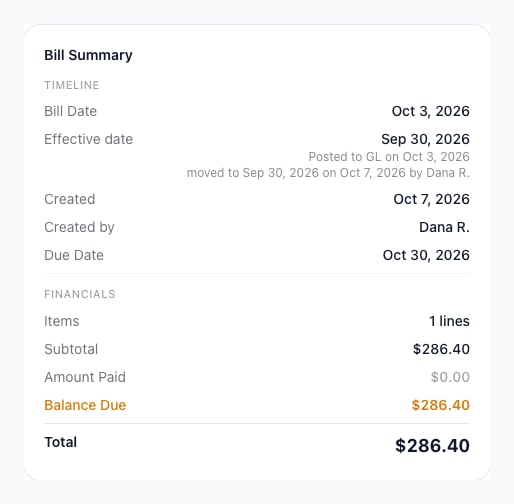
The **Bill Summary** on the bill then shows the new **Effective date**, the date the bill first posted
(**Posted to GL on**), and when and by whom it moved.
## Where You Choose The Dates
| Where the bill comes from | Bill date | Effective date |
| - | - | - |
| **Enter Bill** on AP Bills, or **New Bill** on a purchase order's **Vendor Bills** card (the same form, with the purchase order and vendor filled in) | You pick it. | You pick it. Blank means the bill date. |
| **Create Bills** on the GRNI Report (goods received, not invoiced) | The **Bill Date** you pick, once for every purchase order you selected. | The **Effective Date** you pick, once for the selection. Blank means the bill date. |
| **Write a Check** (a quick check) | The check date. | The check date. A quick check cannot be dated ahead of today. |
| A **Recurring Bills** template | The scheduled run date, moved by the template's **Bill date offset**. | The bill date, moved by the template's **Effective date offset**. |
| **Receive Items** with **Create vendor bill automatically** | The day you receive, by the server's day. | The same day. |
| **Record bill + payment** on a bank line | The bank line's date. | The same date. |
| A lease payment on the vendor bill route | The lease period you are paying. | The same date. |
What happens when a date is not allowed depends on who chose it:
* **You pick the date** (the first three rows): Arcus refuses a date the posting window or a closed
period does not allow, and a dialog or a banner says why. The steps are in
[AP Bills](/support/accounting/ap-bills#posting-date),
[GRNI and PO-Linked Vendor Bills](/support/accounting/grni-po-bills#choose-the-dates) and
[Write a Check](/support/accounting/write-check#choose-the-check-date).
* **The date comes from the work** (receiving and a bank line): a refused date creates no bill and
Arcus says why. A receipt still stands without its bill. See
[Receive Items](/support/purchasing/create-manage-pos#receive-items) and
[Bank Transactions](/support/accounting/bulk-recategorize).
* **Nobody is there to answer** (a recurring template and a lease payment): the bill posts on its
date when the date is allowed. Otherwise it posts on today's date, and the bill's activity history
records the date that was asked for and why it moved. See
[Which Date the Bill Posts On](/support/accounting/recurring-bills#which-date-the-bill-posts-on) and
[How Lease Payments Post](/support/accounting/leases#how-lease-payments-post).
## The Posting Window
Two company settings limit how far from today a date you choose may be. Both are under
**Settings > System > Fiscal Year**, and [Fiscal Year](/support/settings/fiscal-year) shows where to
change them.
* **Days a journal entry may be backdated** (the **Journal entry backdating** card) is 180 days unless
you change it. A posting date further back than that is refused.
* **Days ahead a posting date may be set** (the **Future posting dates** card) is 0 days unless you
change it. A posting date after today is refused until you raise it.
Each takes a whole number from 0 to 3650. The windows cover the dates on vendor bills and manual
journal entries. Payments and receipts keep their own rules.
A date beyond a window is not a dead end. A person with permission to close periods can post it by
giving a reason of at least four characters, which is recorded on the audit trail, as long as an open
accounting period covers the date. For that person the Enter Bill form asks for the reason as soon as
they pick such a date. Everyone else sees that the date needs the permission. A bill that waits for
approval is checked again when it is approved, against the window as it stands that day, and the
approver gives the reason then.
**The forward window starts at 0**
Until someone raises it, a bill dated after today is refused unless it is posted with a reason. Raise
it under Fiscal Year if your team books bills ahead of their invoice date.
## Closed Months And Locked Tax Years
The window is not the only check. A posting date also has to land in a month that is still open and
in a tax year that is not locked.
* **A closed month.** A date in a closed or year-end closed accounting period is refused whatever the
window says, and a reason cannot override it. The dialog's title ends **the posting date is in a
closed period**, and it reads: "The posting date falls in the closed period (period name), so
nothing can post there." When an open period follows, it goes on: "The next open period starts
(date). Pick a date there, or reopen the period from Period Close." and **Use (date)** puts that
date in the form. When none follows, it says "Pick a date in an open period, or reopen the period
from Period Close." and has no **Use** button. A month whose close is only requested, and so still
**Pending approval**, still takes postings.
* **No period for the date.** A date beyond the window needs an open accounting period that covers it.
When none does, the title ends **no accounting period covers that date** and the dialog says to
generate the period from Period Close first, or pick another date.
* **A locked tax year.** A date in a tax year you locked is refused with a title that ends **the tax
year is locked**. Ask someone who can unlock the year (see [1099 Vendors](/support/accounting/1099-vendors#lock-a-tax-year)),
or pick a date in an unlocked year.
## Move A Posted Bill's Date
To change when a posted bill hits the books, open the bill, choose **Edit Bill**, change **Effective
Date** and give a reason. [Work a Bill](/support/accounting/ap-bills#work-a-bill) walks through the
dialog. You need permission to post accounting. A date beyond the posting window also needs permission
to close periods and a reason, the same as when you enter a bill.
Arcus never reverses or re-posts the bill to move it. Instead it:
* Posts two linked **Correction** entries in one step. The first takes the bill's lines out of the date
they were posted on, so that month nets to zero on every account. The second records the same lines
on the new date. The original entry is left as it is. On the first move both corrections name the
original entry. On a later move both name the second entry of the move before.
* Moves the effective date. The due date follows when it was worked out from the payment terms; a due
date you set by hand is kept.
* Leaves payments, their entries and the balance due alone.
* Writes one entry in the bill's activity history and in the Audit Log. It names the old and new
dates, both correction entry numbers and your reason (4 to 500 characters).
The **Bill Summary** on the bill then shows the new **Effective date**, the date the bill first posted
(**Posted to GL on**), and when and by whom it moved.
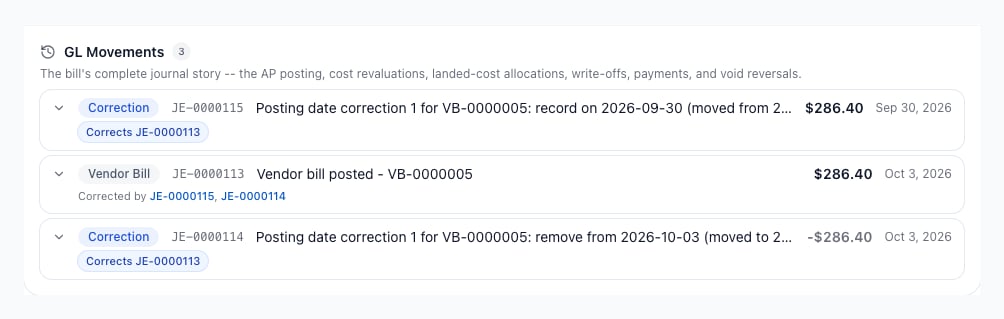
 On the bill, **GL Movements** lists the original entry and its corrections. Each correction carries a
**Correction** chip and **Corrects (entry number)**, and an entry that was corrected reads **Corrected
by (entry numbers)**. In Journal Entries, **Filter** with **Entry kind** set to **Corrections only**
lists them. Moving the date again works the same way: the second move takes the bill off the date the
first move put it on, so its two entries name the first move's second entry, and that entry reads
**Corrected by** them.
On the bill, **GL Movements** lists the original entry and its corrections. Each correction carries a
**Correction** chip and **Corrects (entry number)**, and an entry that was corrected reads **Corrected
by (entry numbers)**. In Journal Entries, **Filter** with **Entry kind** set to **Corrections only**
lists them. Moving the date again works the same way: the second move takes the bill off the date the
first move put it on, so its two entries name the first move's second entry, and that entry reads
**Corrected by** them.
 A bill cannot be re-dated when:
* It was imported from your previous system. Its dates are part of the migrated history.
* It is voided or written off.
* It is linked to a purchase order, or it carries a revaluation or landed-cost entry. Moving it would
also have to move inventory and goods received, not invoiced entries, which Arcus does not support
yet. Void it and enter it again instead.
* The new date is after the bill's first payment or credit. The date can move to that day or earlier,
never after it, or the vendor's balance would run negative in between.
* The date it is leaving, or the date it is moving to, is in a closed period or a locked tax year.
## Purchase Orders And Receiving
A purchase order posts nothing to the ledger. The ledger moves when goods arrive and when the bill
posts, and each uses its own date:
* **Receiving** posts on the day you receive the goods: inventory goes up and goods received, not
invoiced (GRNI) goes up. A later bill never changes that date.
* **The bill** posts on its effective date. That is when the bill relieves GRNI and records the
payable, so the bill's posting date decides which period the relief, and any expense or inventory
cost the bill adds, land in. A purchase order received in September and billed with an October
effective date shows the goods in September and the bill in October.
The [GRNI Report](/support/accounting/grni-po-bills)'s **As of** date follows the same split: a receipt
counts from the day it was received and a bill from its posting date.
[Three-way match](/support/accounting/3-way-match) compares quantities and prices, never dates, so a
bill's bill date and effective date do not change whether it matches its purchase order and receipt.
## Reports That Follow The Posting Date
Anything that asks which bills existed on a date counts a bill from its posting date, so the payables
detail and the ledger agree about the same bill:
* **AP aging as of an earlier date** counts a bill from the day it posts. A past-due bill's age still
counts from its due date.
* **The payables comparison** (the vendor bill detail against the payables control account) counts a
bill from its posting date wherever it is read as of a date: the **Subledger Drift** events on the
[Calendar](/support/accounting/calendar) and the check at a period close.
* **Period Close** counts the open vendor bills in a period, and its payables comparison at the
period's end, by posting date. See
[Which Vendor Bills Count Toward a Period](/support/accounting/period-close#which-vendor-bills-count-toward-a-period).
* **The GRNI Report's As of date** counts a bill from its posting date and a receipt from the day it
was received (see [Purchase Orders And Receiving](#purchase-orders-and-receiving)).
## What Is Not A Posting Date
* **A payment's date.** A payment posts on the date you choose when you pay. Moving a bill's posting
date never moves its payments, and the posting date cannot move past the bill's first payment.
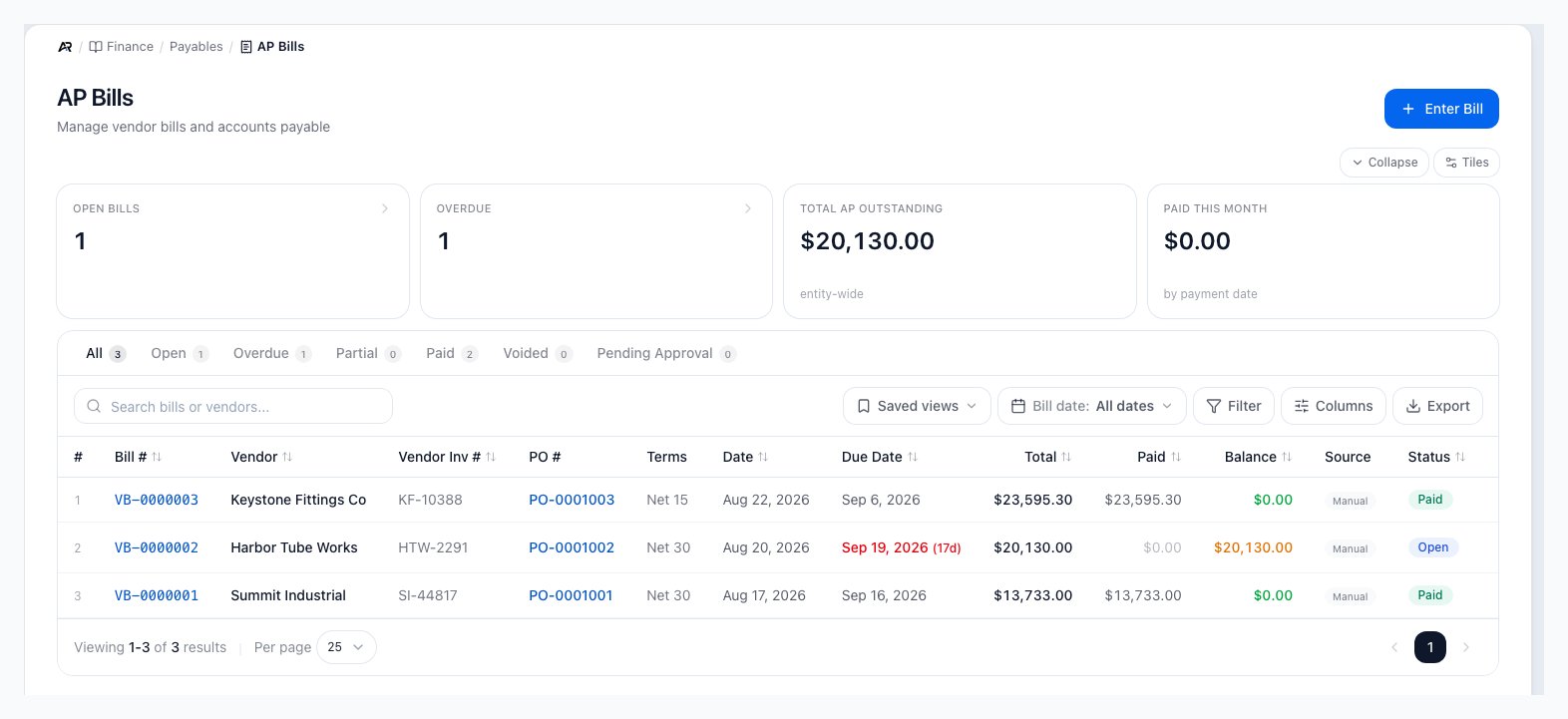
* **The bill date on the AP Bills list.** The list's **Date** column, its date range and its export
show the bill date. A bill dated September 28 that posts on October 1 appears in a September list and
in October's books. Open the bill to see its **Effective date**.
* **The 1099 year.** A vendor's 1099 total adds up posted AP payments by each payment's own date inside
the tax year, so moving a bill's posting date does not move what you paid into another year. A balance
written off with **Write Off Balance** counts as a payment dated on the bill's effective date, so moving
the effective date of a bill you later write off moves that amount's year. See
[1099 Vendors](/support/accounting/1099-vendors).
* **The early-payment discount deadline.** It counts from the bill date, because a vendor's discount
terms run from the invoice date.
A bill cannot be re-dated when:
* It was imported from your previous system. Its dates are part of the migrated history.
* It is voided or written off.
* It is linked to a purchase order, or it carries a revaluation or landed-cost entry. Moving it would
also have to move inventory and goods received, not invoiced entries, which Arcus does not support
yet. Void it and enter it again instead.
* The new date is after the bill's first payment or credit. The date can move to that day or earlier,
never after it, or the vendor's balance would run negative in between.
* The date it is leaving, or the date it is moving to, is in a closed period or a locked tax year.
## Purchase Orders And Receiving
A purchase order posts nothing to the ledger. The ledger moves when goods arrive and when the bill
posts, and each uses its own date:
* **Receiving** posts on the day you receive the goods: inventory goes up and goods received, not
invoiced (GRNI) goes up. A later bill never changes that date.
* **The bill** posts on its effective date. That is when the bill relieves GRNI and records the
payable, so the bill's posting date decides which period the relief, and any expense or inventory
cost the bill adds, land in. A purchase order received in September and billed with an October
effective date shows the goods in September and the bill in October.
The [GRNI Report](/support/accounting/grni-po-bills)'s **As of** date follows the same split: a receipt
counts from the day it was received and a bill from its posting date.
[Three-way match](/support/accounting/3-way-match) compares quantities and prices, never dates, so a
bill's bill date and effective date do not change whether it matches its purchase order and receipt.
## Reports That Follow The Posting Date
Anything that asks which bills existed on a date counts a bill from its posting date, so the payables
detail and the ledger agree about the same bill:
* **AP aging as of an earlier date** counts a bill from the day it posts. A past-due bill's age still
counts from its due date.
* **The payables comparison** (the vendor bill detail against the payables control account) counts a
bill from its posting date wherever it is read as of a date: the **Subledger Drift** events on the
[Calendar](/support/accounting/calendar) and the check at a period close.
* **Period Close** counts the open vendor bills in a period, and its payables comparison at the
period's end, by posting date. See
[Which Vendor Bills Count Toward a Period](/support/accounting/period-close#which-vendor-bills-count-toward-a-period).
* **The GRNI Report's As of date** counts a bill from its posting date and a receipt from the day it
was received (see [Purchase Orders And Receiving](#purchase-orders-and-receiving)).
## What Is Not A Posting Date
* **A payment's date.** A payment posts on the date you choose when you pay. Moving a bill's posting
date never moves its payments, and the posting date cannot move past the bill's first payment.
* **The bill date on the AP Bills list.** The list's **Date** column, its date range and its export
show the bill date. A bill dated September 28 that posts on October 1 appears in a September list and
in October's books. Open the bill to see its **Effective date**.
* **The 1099 year.** A vendor's 1099 total adds up posted AP payments by each payment's own date inside
the tax year, so moving a bill's posting date does not move what you paid into another year. A balance
written off with **Write Off Balance** counts as a payment dated on the bill's effective date, so moving
the effective date of a bill you later write off moves that amount's year. See
[1099 Vendors](/support/accounting/1099-vendors).
* **The early-payment discount deadline.** It counts from the bill date, because a vendor's discount
terms run from the invoice date.
 ## Common Problems
* **A bill I entered this month is in last month's reports.** Its effective date is in last month.
Open the bill and read **Effective date** in the summary. If the books should show another month,
move it with **Edit Bill**, or void and re-enter it when it is linked to a purchase order.
* **The bill's summary shows Posted to GL on a date that differs from the effective date.** Read the
line under it. **On the bill date, before bills posted on their effective date** means the bill posted
before October 6, 2026, when the ledger used the bill date. **Held to the day it was entered** means
the entry sits on the day the bill was created: a recurring or lease bill whose date was not allowed,
or a bill posted before October 6, 2026 whose bill date was that day or still ahead. The entry stays on that date
until you move it with **Edit Bill**.
* **Arcus refuses a bill dated after today.** The forward window is 0 days until someone raises it under
**Settings > System > Fiscal Year**. Someone who can close periods can post the bill with a reason.
* **The dialog says the posting date is in a closed period.** Choose **Use (date)** for the next open
date when the dialog offers it, or reopen the month from Period Close.
* **Edit Bill will not move the date.** When **Effective Date** is greyed out, the sentence beside it
names the cause, such as a bill linked to a purchase order. When a dialog opens as you save, its
title says what is wrong, for example **the period it is posted in is closed**.
* **The AP Bills list and my reports show different months.** The list shows the bill date and the
reports use the posting date.
## Related Articles
Enter, approve, edit, pay and void vendor bills, and see the effective date on each bill.
Bill received purchase orders in bulk and choose their bill and effective dates.
Set the bill and effective date offsets a generated bill uses.
Set the backdate and future posting windows.
Close, reopen and review the months a posting date has to land in.
See how a vendor bill's entry is dated and find its correcting entries.
Pick the check date a quick check posts on.
See which date decides a vendor's tax-year total and how a tax year is locked.
This documentation is built and hosted on [Mintlify](https://mintlify.com), a developer documentation platform.
## Common Problems
* **A bill I entered this month is in last month's reports.** Its effective date is in last month.
Open the bill and read **Effective date** in the summary. If the books should show another month,
move it with **Edit Bill**, or void and re-enter it when it is linked to a purchase order.
* **The bill's summary shows Posted to GL on a date that differs from the effective date.** Read the
line under it. **On the bill date, before bills posted on their effective date** means the bill posted
before October 6, 2026, when the ledger used the bill date. **Held to the day it was entered** means
the entry sits on the day the bill was created: a recurring or lease bill whose date was not allowed,
or a bill posted before October 6, 2026 whose bill date was that day or still ahead. The entry stays on that date
until you move it with **Edit Bill**.
* **Arcus refuses a bill dated after today.** The forward window is 0 days until someone raises it under
**Settings > System > Fiscal Year**. Someone who can close periods can post the bill with a reason.
* **The dialog says the posting date is in a closed period.** Choose **Use (date)** for the next open
date when the dialog offers it, or reopen the month from Period Close.
* **Edit Bill will not move the date.** When **Effective Date** is greyed out, the sentence beside it
names the cause, such as a bill linked to a purchase order. When a dialog opens as you save, its
title says what is wrong, for example **the period it is posted in is closed**.
* **The AP Bills list and my reports show different months.** The list shows the bill date and the
reports use the posting date.
## Related Articles
Enter, approve, edit, pay and void vendor bills, and see the effective date on each bill.
Bill received purchase orders in bulk and choose their bill and effective dates.
Set the bill and effective date offsets a generated bill uses.
Set the backdate and future posting windows.
Close, reopen and review the months a posting date has to land in.
See how a vendor bill's entry is dated and find its correcting entries.
Pick the check date a quick check posts on.
See which date decides a vendor's tax-year total and how a tax year is locked.
This documentation is built and hosted on [Mintlify](https://mintlify.com), a developer documentation platform.